



Progress doesn’t wait for the perfect moment. Mr. Shailesh Chandra said it belongs to those who see possibilities when others see limitations and have the courage to act before the future arrives.
Some companies manufacture cars. Tata Motors Passenger Vehicles (TMPV) has spent more than three decades building a more lasting relationship – with India itself. At the heart of this story is a hugely influential number – seven million. There are seven million cars on Indian roads. 7 million families choose to make Tata a part of their lives. But to understand what seven million really means, you have to go back to where it all started.
humble beginnings
Our journey begins with a firm belief: if innovation can improve people’s lives, it should not remain the privilege of a few. This belief led India to launch the Tata Sierra in 1991 – the first passenger car from Tata Motors (previously known as Tata Engineering and Locomotives – TELCO). This was followed by the launch of Estate and Sumo in 1994, expanding the product portfolio.
The real turning point came in 1998, when the carmaker showcased India’s first indigenously developed passenger car, the Tata Indica, at the Geneva Motor Show. As an authentic “Indian car”, it quickly occupied the first place in the Indian market within two years. Indica’s slogan: “More Cars per Car” became a manifesto of self-reliance and gave OEMs the confidence to dream bigger. The Safari, launched in the same year, followed and became a symbol of desire and adventure, defining the SUV lifestyle for an entire generation of Indians.
Nano Nightmares and Dark Years
In 2003, the company changed its name to Tata Motors Ltd. to better reflect its core automotive business rather than its general engineering business. Tata Motors was so successful that it launched the Nano in 2008, the world’s cheapest car priced at Rs 1 lakh, with the dream of replacing two-wheeled families with four-wheeled vehicles. While the idea was visionary, the execution was painful. Production plant relocations, engine fires, poor build quality, and reliability issues tarnished its reputation early on. But the deepest wound is perception – aspiring Indians refuse to see the world’s cheapest car. Nano was quietly discontinued in 2018.
Mr. Shailesh Chandra, Managing Director & CEO, TMPV
Indica’s success proved equally short-lived. The company’s passenger car business took a serious hit in the early 2010s as safety concerns, stiff competition and the failures of Sumo and Indigo eroded market share.
Safety and turnover
In 1997, Tata Motors set up India’s first crash test facility in Pune, years ahead of the industry. In 2018, Nexon paid off as it became the first car in India to receive a five-star rating from Global NCAP, transforming safety from an engineering discussion to a household conversation and raising the bar across the industry.
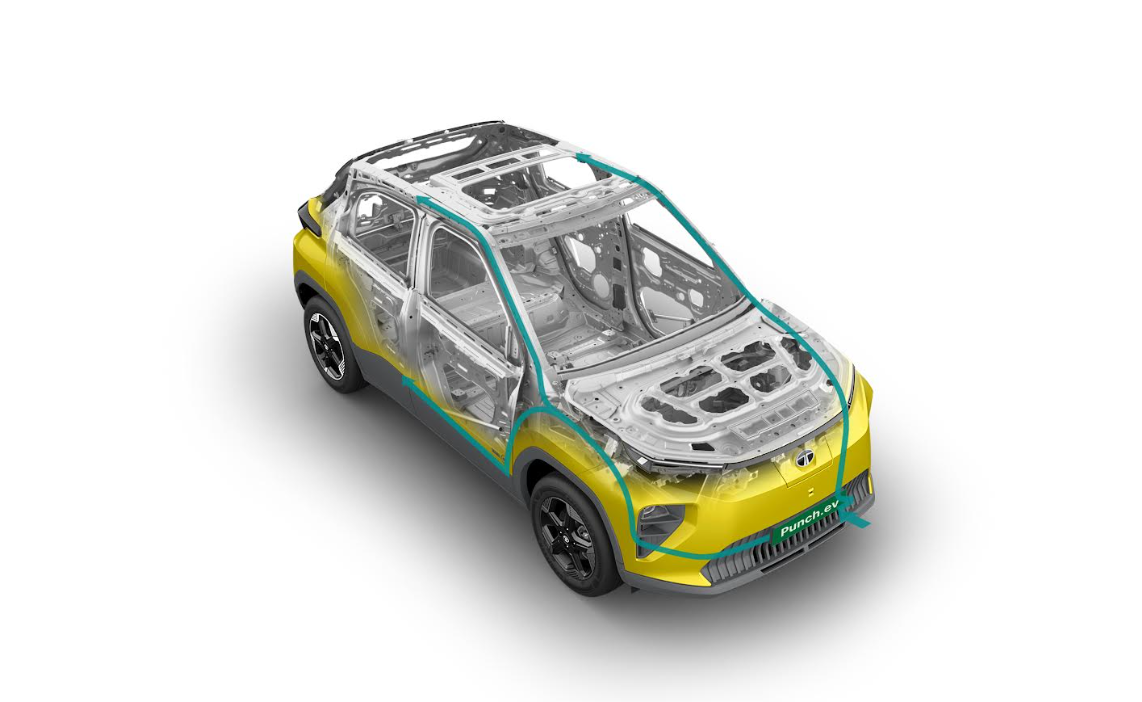
The Tiago had already started to turn around in 2016, followed by the Nexon, Altroz and Harrier, which together accounted for 60% of Tata’s sales in fiscal 2021. Launched in 2021, Punch has single-handedly created the micro SUV segment and holds a leading position in Tata’s product portfolio, with 20,208 units sold in May 2026, accounting for 34.2% of the total monthly sales.
Electric Jump and Serah’s Return
Apart from product renaissance, Tata Motors has also built a complete EV ecosystem. Launched in 2020, the Nexon EV was followed by the Tiago EV, Punch EV and Curvv EV, providing the market with the broadest electric vehicle portfolio from a single manufacturer. And then there’s a full-circle moment – the Sierra returns in the third quarter of fiscal 2026, the nameplate that started it all, reborn as a modern SUV, with an EV version to follow.
Seven million and counting.
Tata Motors started producing passenger cars in 1991. The brand achieved the one-million-unit production milestone in 2004, reached its second millionth unit in 2010, crossed three million units in 2015, and crossed four million units in 2020. From 4 million to 7 million vehicles in just six years – the growth rate tells its own story.
Thirty-five years – that’s how long it took to go from one car – the Sierra – built in a Pune factory to seven million cars on Indian roads. From a company that established itself in the passenger car segment to pioneering safety, spearheading the electric revolution and building some of India’s most admired SUVs, it is, at its heart, a story of ups and downs and resilience, lessons learned the hard way, and a company that refuses to give up on its belief that it can build world-class mobility in India, for India.
It is at this moment, when momentum is at its peak and Tata Motors is to be demerged in October 2025 (separating commercial vehicles and photovoltaic businesses), that TMPV has chosen to take the next step. Not just new products, but a new identity that reflects everything Journey represents and everything to come.
India has given us a name
Mr. Shailesh Chandra, Managing Director and CEO of TMPV, said the sales of 7 million vehicles is not the end point. This is a springboard and the backdrop against which TMPV chooses to launch new products. When Indian families bring home a new car, they never call it a hatchback or SUV. They simply said: “We bought a Tata car. Those words carry the reassurance of the Tata name, the pride of Indian engineering and the confidence that this car has been created with a deep understanding of India and its people. In many ways, TATA.CARS is not a name invented by the carmaker. It is a name given to them by India. Today, we are just making it official,” Mr. Chandra said.
As he says, “Progress does not begin when all challenges are solved. Progress only begins when one has the courage to see possibilities where others see limitations, and has the conviction to move forward before the future arrives. This has always been the story of Tata Motors – seeing possibilities before they become apparent, understanding customers’ needs before they ask for them, and transforming bold ideas into meaningful progress,” he explains.
next chapter
The path ahead is being shaped by a completely different generation – one that is more confident, more expressive and more ambitious than any that came before. This generation doesn’t just want great products. It wants brands to reflect who they are and what they stand for.
As India looks to the future, more restless and ambitious than ever, the core promise of TATA.CARS could not be more appropriate. He said that for every family that begins a new chapter, for every dream that refuses to be limited by circumstances, and for every journey that India has yet to imagine, Tata Motors will make it possible.
“The name is new, but the belief behind it is not. The same belief that has guided the company from its first car to its seventh millionth car – that mobility should open doors, expand possibilities and help people go further than they thought. Because when India sits in a Tata car, nothing is too far,” Mr. Chandra concluded.
NOTE: The first photo is for reference only.