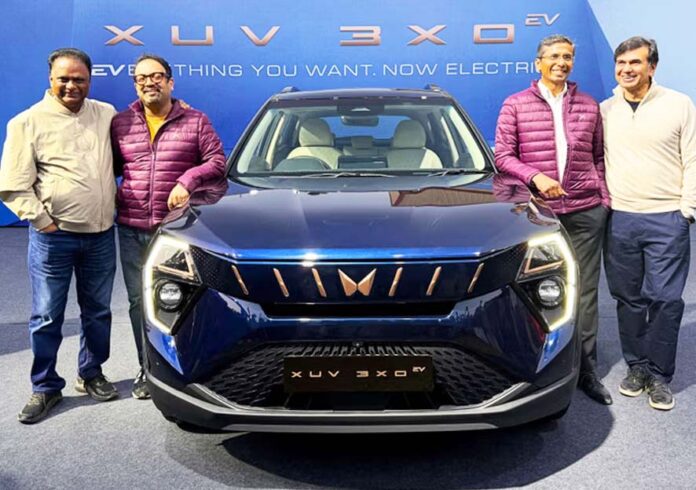
India’s leading SUV maker Mahindra & Mahindra Limited has introduced an electric powertrain in its XUV 3XO range with the launch of the XUV 3XO EV, priced at ₹13.89 lakh. The new electric SUV is designed to meet the aspirations of modern, discerning customers by combining urban design, strong performance, advanced safety and cutting-edge technology.
The XUV 3XO EV is offered in two variants – AX5 and AX7L and is powered by a 39.4 kWh battery, which offers a real-world driving range of up to 285 km. Performance highlights include a 0-100 km/h acceleration time of 8.3 seconds, with the electric motor producing 110 kW of power and 310 Nm of torque.
On the technology front, the electric SUV is equipped with Level 2 ADAS, which includes lane keep assist, autonomous emergency braking, smart pilot assist, and adaptive cruise control. It also has Adrenox connected car technology with over 80 connected features and built-in Alexa.
Further enhancing the comfort and safety is a 7-speaker Harman Kardon premium audio system with Dolby Atmos, a 360-degree surround view camera and a blind view monitor.
Design-wise, the XUV 3XO EV sports a confident, contemporary stance that is instantly recognizable as part of the XUV 3XO family. The interiors blend modern aesthetics with a premium ambiance, ensuring comfort on every journey. Along with its stylish appeal, the XUV 3XO EV also promises practical and affordable ownership. Customer deliveries are scheduled to begin on February 23, 2026.
Variant-wise pricing (ex-showroom):
AX5: ₹13.89 lakh AX7L: ₹14.96 lakh
Launched in April 2024, the XUV 3XO offered a range of segment-leading features, setting a new benchmark for the subcompact SUV segment. It has been a resounding success achieving approximately 1.8 lakh sales since its launch. The XUV 3XO EV is built on this premise for customers who typically use the vehicle for urban commuting and want an electric SUV that feels like a smart next step.
Nalinikant Golagunta, Chief Executive Officer – Automotive Division, Mahindra & Mahindra Limited, said, “The XUV 3XO has rewritten the rules by bringing together aspiration and accessibility at scale. With the Sure to meet everyday mobility needs, it combines instant electric performance with a package that is designed for confidence and ease in city driving.
Montra Electric, the clean mobility arm of Murugappa Group, has strengthened its presence in the National Capital Region (NCR) with the opening of two new dealerships. The company has opened an electric small commercial vehicle (E-SCV) dealership in Libaspur in North Delhi and an electric three-wheeler (E-3W) dealership in Surajpur, Greater Noida.
Both these changes further strengthen Montra Electric’s presence in NCR, a region that is fast emerging as one of India’s most active markets for electric commercial vehicles. Growing demand for urban logistics, shared passenger mobility and increasing deployment of fleets for intra-city operations are driving growth in the sector, as electric vehicles transition from pilot projects to mainstream commercial use.
The Greater Noida E-3W dealership, operated by Wigson Automobiles, will cater to individual owner-operators as well as fleet customers across the last mile passenger and cargo segments. The outlet will retail Montra Electric’s Super Auto and Super Cargo and includes service infrastructure with trained EV technicians to support faster turnaround and higher vehicle uptime; Key considerations for commercial operators with daily use.
The North Delhi e-SCV dealership, powered by Action Volt Wheels by Action Earth Movers Group, will support businesses deploying electric SCVs for middle-mile and intra-city logistics. The facility is designed for applications such as e-commerce distribution, FMCG movement and urban freight movement, with workshop and after-sales capabilities designed to meet fleet expectations around reliability and service response.
TI Clean Mobility’s senior leadership attended the inauguration, including Arun Murugappan, President, Montra Electric (TI Clean Mobility), Jalaj Gupta, Managing Director, Montra Electric (TI Clean Mobility), Saju Nair, CEO-e-SCV, Montra Electric and Deependra Sharma, CEO, E-3W Montra Electric, who indicated the strategic importance of NCR within the company’s national expansion plans.
Commenting on the expansion, Arun Murugappan said, “The transition to electric commercial mobility is an institutional shift, not just a product change. As adoption expands across India, its success will depend on the strength and reliability of the supporting ecosystem. Building this foundation, based on quality, service and long-term ownership trust, is essential to scale up clean mobility in a sustainable manner.”
On the occasion of the dealership announcements, Jalaj Gupta said, “Delhi-NCR is one of the most structurally important markets for electric commercial vehicles, where scale is being driven by real operational use-cases rather than experimentation. Our focus is to build a network that is able to support this scale through trusted retail partners, strong service infrastructure and consistent customer engagement. The new dealerships in Greater Noida and North Delhi are a step towards ensuring that That customers experience electric mobility as a reliable business solution, not just a sustainable option.”
The NCR expansion reflects Montra Electric’s broader vision of strengthening the retail and service network in markets where commercial EV adoption is gaining depth. As deployments in last-mile and middle-mile applications increase, the company expects NCR to remain a key region for continued growth.
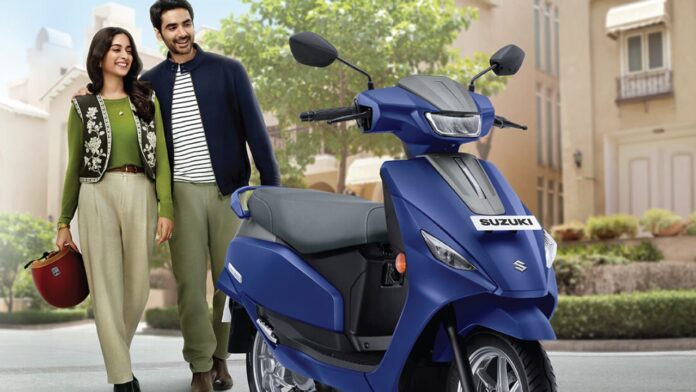
No More Worries About Petrol Suzuki’s First Electric Scooter Has Been Launched Find Out The Price – Now the tension of petrol is over! Suzuki’s first electric scooter launched, know the price.
Hindi News »
automobile »
No More Worries About Petrol Suzuki’s First Electric Scooter Has Been Launched Find Out The Price
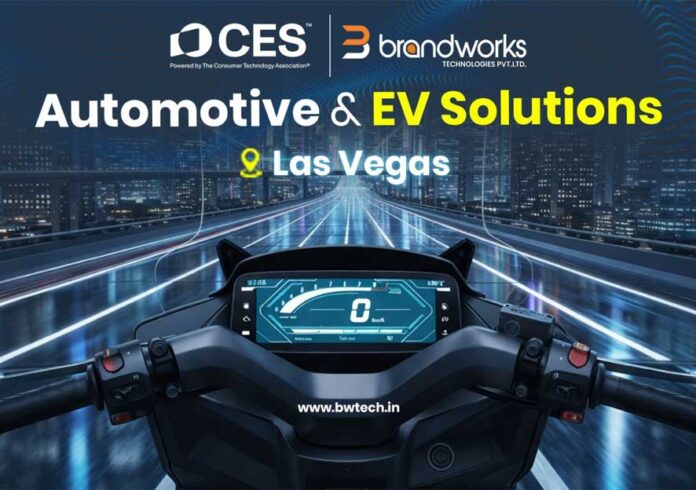
Brandworks Technologies, a fast-growing, design-driven and R&D-led electronics manufacturing company from India, entered the global automotive and electric mobility ecosystem at CES 2026, underscoring India’s growing stature as a hub of advanced electronics design, engineering and manufacturing.
At the global technology showcase, Brandworks unveiled its portfolio of automotive and EV electronics solutions, including powertrain systems, vehicle electronics, charging solutions and connected mobility platforms. The announcement signals the company’s strategic expansion from consumer and industrial electronics to automotive-grade systems, supported by strong in-house capabilities in R&D, systems engineering and manufacturing.
Brandworks’ move is in line with the growing momentum of India’s electronics manufacturing ecosystem, which has demonstrated the ability to deliver mass production over the last decade. Building on this foundation, the company aims to move up the value chain by building design ownership, deep engineering capabilities and strengthening long-term partnerships with automotive OEMs, thereby establishing itself as a major player in next-generation mobility electronics.
“Our participation at CES is a statement of intent,” said Nikita Kumawat, co-founder and managing director of Brandworks Technologies. “India is no longer just a manufacturing base. It is rapidly growing where complex systems are being designed, engineered and industrialized. Brandworks is being built to support that transformation.”
Brandworks’ automotive and EV expansion is based on three core capabilities: in-house R&D, system-level design and scalable manufacturing. The company works across the entire lifecycle from concept and co-development to validation and production, helping OEMs reduce time to market while maintaining quality, reliability and cost control.
By focusing on platforms rather than point products, Brandworks aims to address a key challenge facing the mobility industry: fragmentation between hardware, software, electronics, and manufacturing partners. Its integrated approach allows OEMs to work with a single partner across multiple vehicle segments and future technology changes.
CES 2026 also provided an opportunity for Brandworks to engage with global OEMs, technology partners and ecosystem players on collaboration models, localization strategies and India’s emerging role in the global electronics supply chain. The company highlighted its intention to deepen partnerships, invest further in R&D talent, and strengthen India-based design and manufacturing capabilities for global markets.
Looking ahead, Brandworks plans to continuously localize key automotive and EV electronics, strengthen its R&D footprint, and scale up its manufacturing operations to support both Indian and international customers. The company’s long-term vision is to help establish India as a reliable, innovation-led electronics hub for next generation mobility.
Brandworks Technologies Private Limited is an Indian design-based electronics company focused on R&D and high-precision manufacturing, providing advanced solutions in AI, IoT, automotive electronics, power and charging, audio systems and renewable energy.
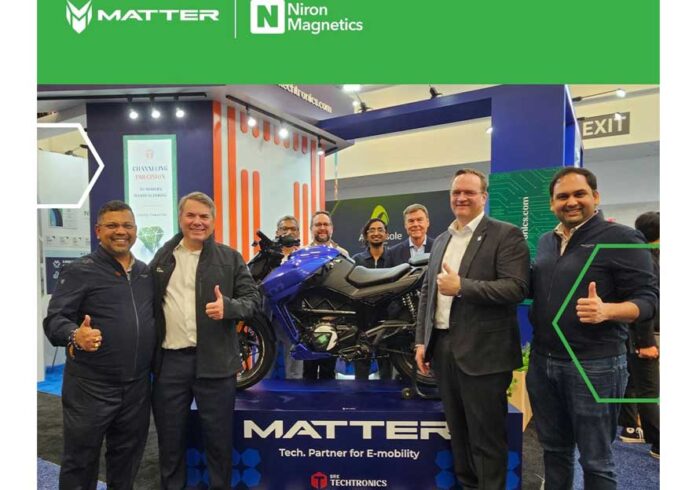
Electric mobility technology company MATTER has announced a collaboration with Niron Magnetics to develop rare-earth-free electric motor technology for two-wheelers. The first prototype featuring this innovation was unveiled at CES 2026.
The collaboration aims to address the electric vehicle industry’s heavy reliance on rare earth elements, which creates environmental concerns and supply chain vulnerabilities. As part of the partnership, MATTER will explore integrating Niron Magnetics’ iron nitride magnet technology along with variable flux motor (VFM) designs into its next-generation electric motorcycle platforms.
The prototypes displayed include MATTER’s liquid-cooled powertrain, in-house developed gearbox and vehicle systems integrated with Niron Magnetics’ iron nitride permanent magnets. Built on MATTER’s Hypershift geared electric motorbike platform, the prototype aims to improve torque delivery, efficiency across a wide speed range, acceleration performance, riding range and thermal stability.
Variable flux motor technology eliminates the traditional trade-off between low-speed torque and high-speed efficiency seen in conventional electric motors. For electric motorcycles, this translates into faster acceleration, better urban riding controllability, efficient highway cruising and better thermal performance. Niron Magnetics’ iron nitride magnets achieve these benefits without the use of rare earth elements or critical minerals.
Commenting on the collaboration, Prasad Telikapalli, Founder and Group CTO, Matter, said: “Our endeavor has always been to create future-ready electric mobility solutions that deliver unmatched performance while strengthening India’s technological independence. Niron Magnetics’ iron nitride technology represents a step-change in electric motor capability, and together we see an opportunity to redefine two-wheeler propulsion globally.”
Mohal Lalbhai, Founder and Group CEO of MATTER, said: “By integrating Niron Magnetics’ iron nitride variable flux motor technology into our platform, we are breaking long-standing barriers around performance, efficiency and sustainability, and expanding what electric mobility can achieve for India and beyond.”
Jonathan Rowntree, CEO of Niron Magnetics, said: “Partnering with MATTER allows us to demonstrate how iron nitride magnets can open new frontiers in high-performance e-mobility. MATTER’s technology-first mindset and powertrain expertise make them an ideal partner to scale rare-earth-free magnet innovation to production applications.”
Established in January 2019 and headquartered in Ahmedabad, MATTER Motor Works manufactures AERA geared electric motorbikes and holds over 400 patent filings with 97 granted patents. Niron Magnetics specializes in the production of permanent magnets using iron nitride material formulations, providing a sustainable alternative to rare-earth-based magnet technologies.
Making This Small Mistake While Charging Can Be Costly Both Your Ev And Your Family Could Be At Risk – Making This Small Mistake While Charging Can Be Costly, Both Your EV And Your Family Could Be At Risk!
Hindi News »
automobile »
Making This Small Mistake While Charging Can Be Costly Both Your Ev And Your Family Could Be At Risk
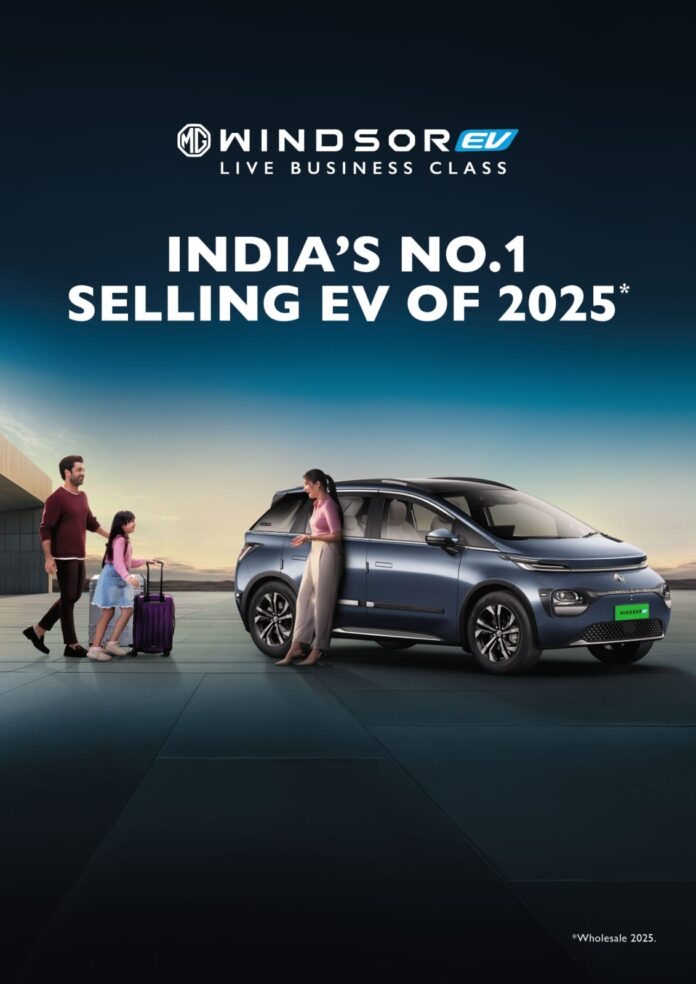
JSW MG Motor India on Tuesday announced that the MG Windsor has become India’s number one selling electric vehicle by 2025, setting a new benchmark in the Indian four-wheeler electric vehicle market. Windsor sold 46,735 units throughout the year, setting the highest annual sales record ever for an electric vehicle model in India.
The MG Windsor’s strong performance is driven by its appeal to family buyers, coupled with its spacious interior, high comfort, feature-rich cabin and refined driving experience. The model quickly became one of the most popular and award-winning electric vehicles in the country.
Commenting on this milestone, Mr. Anurag Mehrotra, Managing Director, JSW MG Motor India said, Windsor represents a modern automotive product that reshapes expectations in the electric mobility space through its practicality, advanced technology and futuristic design. He noted that the model plays a key role in accelerating EV adoption by converting hesitant buyers into EV owners and brand advocates. Mehrotra added that the company hopes to build on this momentum and make 2026 even more important.
Strong demand for Windsor also helped JSW MG Motor India post an overall growth of 19% in FY25, while EV sales surged 111% compared to FY24. The company highlighted that demand for MG electric vehicles is growing steadily not only in first-tier cities, non-metros and emerging markets, reflecting India’s increasing readiness for sustainable mobility.
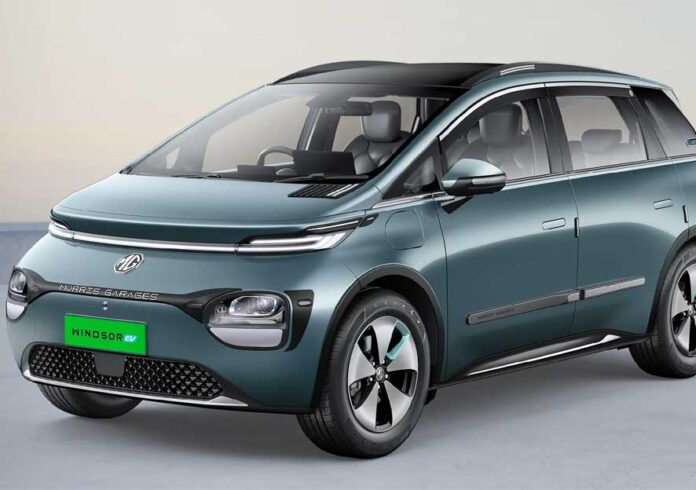
Positioned as India’s first smart CUV, MG Windsor combines the comfort of a sedan with the versatility of an SUV. Battery-as-a-service pricing starts at Rs 9.99 lakh, plus Rs 3.9 per km. The electric vehicle delivers 100 kW of power and 200 Nm of torque, and is available with two battery options: a 38 kWh battery pack with a range of up to 332 km, and a 52.9 kWh PRO model with a range of up to 449 km.
Windsor adopts MG’s AeroGlide design language and is designed to transcend the traditional vehicle realm. Inside, it offers business class comfort with Aero Lounge seats that recline up to 135 degrees and a 15.6-inch GRANDVIEW touchscreen on the center console designed to enhance ease of use and the overall driving experience.
Freedom From Petrol Electric Scooter Sales Set A New Record In 2025 Find Out Who Became Number One – Freedom From Petrol! Sales of electric scooters set a new record in 2025, know who became number-1.
Hindi News »
automobile »
Freedom From Petrol Electric Scooter Sales Set A New Record In 2025 Find Out Who Became Number One
Maharashtra has retained its position as India’s leading state for electric passenger vehicle (e-PV) adoption, registering the highest demand for electric cars, SUVs and MPVs in CY2025. The state has more than doubled its electric passenger vehicle sales year-on-year, led by strong growth in the country’s financial capital Mumbai.
In CY2025, Maharashtra recorded retail sales of 30,596 electric passenger vehicles, a strong growth of 103% year-on-year compared to 15,038 units sold in CY2024. This performance translated into a record 17% share in India’s e-PV sales during the year, up from 15% share in the previous calendar year.
Apart from passenger vehicles, Maharashtra continued to dominate other key electric mobility segments. The state remained India’s largest market for electric two-wheelers with retail sales of 216,148 units, registering a growth of 3% year-on-year and accounting for 17% share of the national e-2W market. It also retained the top spot in electric commercial vehicle sales, registering 3,971 units – up 72% year-on-year – and a 25% share in the e-CV segment.
However, Maharashtra lagged behind in the electric three-wheeler category. With sales of 15,792 units in CY2025, up 10% year-on-year, the state has only 2% share in the national e-3W market, ranking 10th overall, far behind Uttar Pradesh, which continues to dominate the segment.
Overall, Maharashtra recorded total EV retail sales of 266,524 units in CY2025 across all four segments – two-wheelers, three-wheelers, passenger vehicles and commercial vehicles. This gave the state a 12% share in India’s overall EV market and ranked second nationally behind Uttar Pradesh, which led the country with 404,908 EV sales, mainly driven by its strong presence in the E-3W sector.
According to retail data from the vehicle portal (as of January 7, 2026), India sold a total of 177,054 electric cars, SUVs and MPVs in CY2025, excluding Telangana due to unavailability of data. This represents a strong annual growth of 77% compared to sales of 99,844 units in CY2024, with most of the leading electric passenger vehicle manufacturers reporting significant annual gains.
Top 7 states and Delhi account for 77% of retail sales
Among the states/UTs covered by the vehicle, Tripura is the only state that saw a year-on-year decline in sales: 38 units, down 3% year-on-year. All but a couple have registered high double-digit growth (see detailed vehicle-sourced state/UT sales table below).
Top 7 states and Delhi account for 77% of EV retail sales
Among the states and union territories covered in the vehicle database, Tripura was the only region to record a year-on-year decline in retail EV sales, with volumes falling 3% year-on-year to 38 units. In contrast, almost all other states and union territories recorded positive growth during this period.
Barring a few exceptions, most regions recorded strong double-digit growth year-on-year, underscoring the rapid pace of EV adoption across the country.
A close examination of the state and union territory-wise retail sales data obtained from the vehicle reveals a high level of market concentration at the top. The seven leading states for electric passenger vehicle (e-PV) sales – Maharashtra, Karnataka, Kerala, Tamil Nadu, Uttar Pradesh, Gujarat and Rajasthan – along with Delhi (ranked fifth), each recorded sales of more than 11,000 units in CY2025.
Collectively, these eight markets contributed 137,339 electric cars, SUVs and MPVs during the year, representing a major share of 77% in India’s total e-PV sales in CY2025.
Apart from this leading group, West Bengal and Andhra Pradesh are ranked ninth and tenth with retail sales of 6,046 units and 4,941 units respectively, reflecting a sharp decline in volumes after the peak of the e-PV markets.
After Maharashtra, three southern states – Karnataka, Kerala and Tamil Nadu – occupy the next three ranks. However, with its sales doubling in Maharashtra, the state has eaten into the market shares of other states. While Karnataka, the No. 2 state (20,977 units, 48%) is up, its e-PV share is expected to decline from 14% to 12% in CY2024. Kerala (19,158 units, up 73%) has retained its 11% share, and Tamil Nadu (15,185 units, up 95%) has seen its e-PV share increase from 8% to 9% in CY2024.
Delhi (14,828 units, up 126%, 8% share) ranked fifth followed by Uttar Pradesh (13,718 units, up 99%, 7% share), Gujarat (11,584 units, up 85%, 6.5% share), Rajasthan (11,293 units, up 83%, 6% share), West Bengal (6,046 units, up 78%, up 3% share). Andhra Pradesh (4,941 units, 2.79% share, up 21%).
In CY2025, Tata Motors, JSW MG Motor and Mahindra sold 25,577 e-PVs in Maharashtra, accounting for 17% of the record 176,876 e-PVs sold in India.
Revealed: How Maharashtra ranks for 16 electric car and SUV OEMs
A closer analysis of state-wise retail sales highlights the growing importance of Maharashtra as a key market for India’s 16 electric passenger vehicle manufacturers. The state is playing a key role in increasing volumes among major OEMs.
Market leader Tata Motors eyes 15% of its record electric passenger vehicle sales in CY2025 from Maharashtra. The company sold 10,493 electric cars and SUVs in the state during the year, a year-on-year growth of 26%, out of total e-PV sales of 70,091 units nationwide.
JSW MG Motor India saw its highest-ever e-PV sales at 51,486 units, up 8,573 units and an impressive 124% YoY growth, with state share at 17%. Mahindra & Mahindra, which is riding on strong demand for its BE6 and The combined sales of these top three OEMs in Maharashtra at 25,577 units, up 94% YoY (CY2024: 13,195 units), clearly reflects the strategic importance of the state.
Same is the case for almost all the other 13 players. The above comprehensive data table shows that Hyundai Motor India sold 1,533 units of its e-SUV in the state, mostly the Creta EV. Meanwhile, BYD India sold 1,159 units (21%) of its 5,409 e-PVs in Maharashtra.
Maharashtra also drove strong sales for two new EV makers that entered the Indian market last year: Tesla and VinFast. Tesla sold 140 units of its Model Y in Maharashtra at a price of Rs 60 lakh, which was 62% of its total sales of 226 Model Y in India. And VinFast India saw sales of 144 units of its two e-SUVs – VF6 and VF7 – in the state, which is 17% of its all-India sales of 828 units last year.
For the eight luxury car manufacturers, Maharashtra remains a key growth driver. In CY2025, EV buyers in the state took delivery of 1,415 luxury cars, SUVs and MPVs, up 76% year-on-year (CY2024: 802 units). This is 28% and one-fourth of the all-India sales of 5,124 e-PVs last year.
With competition intensifying in the electric passenger vehicle market – especially between the top three OEMs, Tata Motors, JSW MG Motor India and Mahindra & Mahindra – and more than 10 new electric passenger vehicles scheduled to be launched in CY2026, starting with the Maruti Suzuki e-Vitara, state and UT-wise EV sales performance data provides valuable insights.
Corporate dynamics in India are undergoing a quiet but decisive transformation. Electric two-wheelers are replacing traditional fuel-powered fleets for applications ranging from inter-office commuting to last-mile and intra-city operations. What initially started as a sustainability-based initiative has now evolved into a strategic operational option for businesses focused on efficiency, cost optimization and ESG alignment.
EV rental players are at the forefront of this change, seeing strong growth in the domestic and international mobility markets. By offering flexible, asset-light access to electric vehicles, these companies are enabling enterprises to transition to clean mobility without the complexity of ownership, maintenance or upfront capital investment.
Compared to traditional commuting models, electric vehicles offer a uniquely technology-enabled and future-ready alternative. App-based booking, real-time fleet monitoring, low operating costs and low emissions have made EV rental an increasingly attractive proposition for corporate users. As adoption accelerates across sectors, EV rental platforms are increasingly becoming an integral part of everyday corporate mobility – providing quieter, more comfortable and environmentally responsible rides for the modern workforce.
Why has sustainable mobility gained prominence in the corporate sector?
Sustainability has emerged as a wide-ranging mandate in the corporate world. Employee mobility and business travel are now major contributors to carbon emissions. This can be attributed to the net-zero targets being set by corporations. As more and more conventional vehicles contribute to Scope 1 and 3 emissions, companies are now rethinking their fleet options.
Hence, they are now switching to green mobility with EV rentals. By opting for electric vehicles on rental basis, they can easily reduce emissions. This simple method does not require complex cost planning, making it suitable for every organization. There are various green commuting incentives, ESG-compliant procurement strategies, low-emission mobility programs and carbon-neutral corporate travel, which are making it easier for companies to adopt this sustainable technology.
How do EV rentals add flexibility to corporate models?
In today’s hybrid work model, flexibility has become an important aspect of the process. Companies are now eliminating the rigid cost structures, multi-year leases and fixed vehicle allocations that were offered by traditional modes of transportation. With the EV rental system, they can get the following benefits:
Hybrid and remote workforce mobility
Companies are now in a position to introduce car-pooling systems, shared mobility and electric vehicles for employee’s occasional journeys to work.
Choose between short-term and long-term rental
Companies are able to achieve unmatched flexibility with EV rentals, offering packages ranging from one day to month-long.
optimized mobility options
Companies have the freedom to choose between electric SUVs for corporate travel to compact electric vehicles aimed at local commuting.
Better allocation for seasonal demand
Whenever companies face a temporary workforce expansion, a new team project, or a looming sales campaign, EV rentals can come to their rescue. Companies will also not have to make long-term commitments.
Two-wheeler EV rental allows corporates to rapidly increase mobility, whether it’s enabling delivery associates during seasonal peaks or deploying shared scooters across teams for inter-campus commuting. With flexible plans ranging from 24-hour to long-term rental, organizations are helped to match fleet size with real-time demand.
Traditional commuting models are not able to provide the benefits listed above. EV rental systems have become more affordable and flexible for corporate setups.
How are EV rentals bringing cost-efficiency to the mobility sector?
Inflation and rising fuel prices have always put pressure on corporate budgets. In this economic environment, companies are constantly working on ways to reduce expenses on travel budgets. The EV rental system has significantly helped these companies reduce costs in the following ways:
fewer mechanical failures
To ensure operational productivity, the EV rental industry is able to maintain high vehicle availability with its fast maintenance. Therefore, its downtime is also reduced.
No heavy upfront investment
Traditional methods of transportation require large capital investments. The rental industry helps address this challenge.
low operating costs
The EV industry requires less maintenance capital than fuel-powered vehicles. They also do not require oil changes and engine maintenance.
Better Pricing Model
Packages offered by the EV rental industry often include insurance costs, roadside assistance, servicing and maintenance costs. This helps companies avoid unexpected expenses and also simplifies the budgeting process.
How is corporate mobility integrating the latest technology?
The modern mobility experience is powered by the latest technology models and EV rental system. Companies are now able to operate with utmost ease and transparency with the integration of IoT-enabled systems and digital models. Companies are making full use of the following facilities:
Integrated Cost Control and Billing System
Finance processes have been streamlined by making full use of digital invoicing, charge tracking and consolidated billing cycles.
Better visibility of the fleet
With the availability of maintenance alerts, GPS tracking and battery health monitoring, corporates are able to make better decisions.
full automation
Customers can book electric vehicles and two-wheelers through their mobile app. Companies are also able to customize usage limits, billing, and travel access rules.
A corporate mobility strategy is only as strong as its on-the-ground implementation. With 24×7 breakdown support, on-road battery delivery and preventive maintenance checks, the startup ensures that every ride – whether for employees or delivery partners – remains seamless, safe and sustainable. This is the real value.
How are they able to improve the user experience?
The EV rental industry has enabled companies to create better and greener mobility incentives. The rides offered by the company are now quieter, cleaner and more comfortable. Companies are now able to promote the adoption of EV-rental in their recruitment processes, ESG reports and employee engagement campaigns. This has also helped them improve their image as a responsible and future-ready employer.
What is the future of EV rental in the corporate world?
EV rentals are no longer transactional suppliers. They have emerged as strategic business promoters. With the integration of technology, we will see AI-powered fleet optimization tools, expansion of EV rental networks, increased government support for the EV industry, and a greater integration of renewable energy. The number of specialized EVs designed for corporate use will also increase. The EV industry will be able to supercharge the corporate sector with digital management, shared access and electrification of available resources.
Electric vehicle rental systems have already redefined corporate mobility networks. It is able to combine digital capabilities with flexibility, cost-effectiveness and sustainability. They have given corporates a way forward by enhancing the overall travel experience of employees. They will soon establish themselves as leaders in the future-ready world of mobility.