
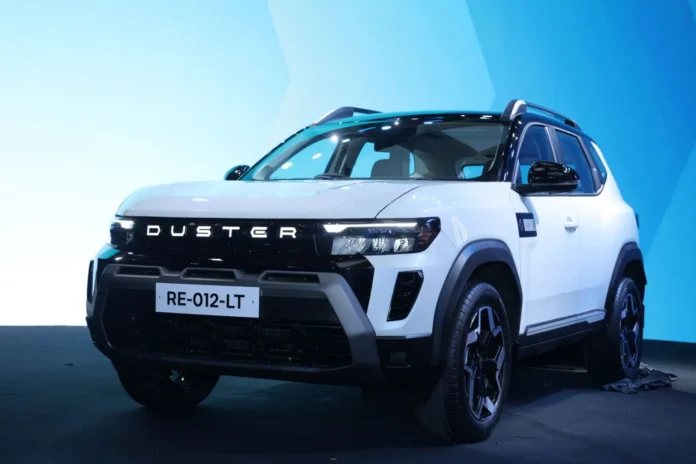

An engine that lies dormant most of the time, a transmission without synchronizers and a battery cooled by refrigerant – this is the engineering behind the new Duster Strong Hybrid E-Tech 160.
For nearly 140 years, buying a car has boiled down to one choice: petrol or diesel. This choice no longer tells the whole story. With older engines reaching their limits, customers now demand not only range and economy, but also lower running costs, better performance and lower emissions.
At the launch of the new Duster Strong Hybrid E-Tech 160, the OEM reiterated that no conventional powertrain can deliver everything customers want, so the industry is turning to hybrids, EVs and other low-carbon options. Buyers no longer ask “petrol or diesel?” but how much range they need, how much the car will cost to run and where they will refuel or recharge. Now, technology is a response to customer demand, and Renault’s answer is full hybrid.
Therefore, Renault has launched the new Duster Strong Hybrid E-Tech 160 in India with an initial price of Rs 16.99 lakh, making three important propositions. It has an ARAI certified fuel efficiency of 29 km/litre. It can operate in pure electric mode for up to 80% of city driving. The OEM says it can deliver up to 29% fuel savings compared to diesel. None of these require charging points. The battery charges automatically when you drive and brake.
How do gasoline SUVs deal with this problem?
Speaking to this publication, Dr. Vikraman, director of engineering at Renault India, said that this is not a clever trick, but the result of five components working together: engine, battery, two electric motors and multi-mode gearbox. To explain this, he goes back more than 130 years, when French teenager Louis Renault was given a car with a 1.75-horsepower engine. He liked the car, but its transmission wasted almost all of the engine’s power before it reached the wheels. So he invented a three-speed transmission and patented it in 1899. The Duster hybrid’s roots lie in this invention, he said, because its smartest part is again the transmission.
An engine that knows when to step in
The first secret, he said, is that this engine isn’t meant to work all the time. When a normal car is waiting at a red light, the engine remains idling, in part to drive the air conditioning compressor. He compared it to running a generator to cool a room, which is inefficient. In the Duster hybrid, an electric compressor takes care of cooling so the engine can remain switched off. He said that for ordinary cars, the engine is on 100% when driving in the city. In this hybrid mode, it’s only on about 20% of the time.
When it wakes up, it works in the best position. In traffic jams, ordinary engines run at low loads and are very inefficient. The hybrid engine starts briefly, runs at its most efficient point, charges the battery and returns to sleep. It never idles in harsh conditions; since the electric motor does the rest of the driving, the engine behaves almost like a small generator.
The 1.8-liter engine is also constructed differently than a regular gasoline engine. It has no belts at all; the starter generator, water pump, and AC compressor are all electric, taking over the belt’s original job so power isn’t lost to friction. The piston has a longer stroke, which converts more of each burn into useful work. It follows the Atkinson cycle where the expansion stroke is greater than the compression stroke, therefore extracting more energy. Its compression ratio is 14:1, compared with about 10.5 for conventional engines. A normal engine will knock at this level. Here, the electric motor steps in before the engine reaches the knock zone. The fuel is injected at a pressure of 350 bar, producing a finer mist and a more homogeneous mixture. A low-pressure exhaust gas recirculation system draws in gases after the particle filter, further calming the mixture. Dr. Vikraman explains that each change only adds a percentage point or two, but they add up to an increase in thermal efficiency from about 35 percent to 41 percent.
Bigger battery, cooled by air conditioning
In his words, the 1.4 kWh battery is almost twice as large as competing batteries, which he believes have a capacity of around 0.6 kWh. “A bigger battery means more power to run. Its cells are inspired by racing cars and can discharge very quickly. The batteries are not cooled by air or water, but directly by refrigerant in the car’s compressor. The system operates at about 250 volts, compared with 160-170 volts of competitors. Higher voltage means less current for the same power, and less current means less heat loss,” he emphasizes.
Engineering elimination, improved efficiency
The most unusual part is the gearbox. Most transmissions use synchronizers, small friction cones that mate with the engine and wheel sides during shifts. They take up space and waste energy. The new car’s engine uses a simple dog clutch instead. When it shifts gears, the starter generator (the electric motor connected to the engine) quickly raises or lowers engine speed to match. The idea came from racing. The space saved is equipped with a larger traction motor, thereby increasing transmission efficiency to 98%.
The engine has four gears and the traction motor has two gears. In electric mode, two forward and two reverse options are available. In hybrid mode, the two can be combined in eight ways. On the highway, the car can be driven in second, third or fourth gear solely on the engine, as some energy is wasted in transferring energy to the battery and back. Dr. Vikraman counted a total of 15 combinations. The driver does nothing. The car can choose from six modes: pure electric, pure engine, two hybrids, regenerative braking and charging.
Why it shines in traffic
That’s why hybrids are most powerful in cities, he said, adding that the engine is switched off at standstill. “It only operates at its best briefly in slow traffic. When you brake, the traction motor converts the car’s movement into electricity rather than heat. So, as traffic gets worse, the gap between hybrids and diesels widens. Both cars use more fuel when stuck in traffic, but the hybrid consumes less. That’s why Renault calls it the best city SUV,” he noted.
The engine and electric motor together produce 160 PS. Renault claims it accelerates from zero to 100 km/h in just 9.61 seconds. With a figure of 29 km/l and a 50-litre fuel tank, the calculated range is over 1,400 km. He was clear that it was the certified number multiplied by the tank size. Real-world results will depend on traffic conditions, driving style and air conditioning usage.
What this means for property owners
According to him, maintenance of the car should be easier since there is no engine belt; the brake pads last longer because the motor is responsible for most of the braking and the engine operates in a narrow, gentle range. The battery has an eight-year warranty. The hybrid adds about 100kg, so the OEM adds frequency-dependent damping to the suspension. Today, engines and gearboxes are imported from Europe, with plans to quickly localize them.
If localization is completed as planned, the most important thing may not be the range of the Duster hybrid, but how many diesel loyalists it wins over.