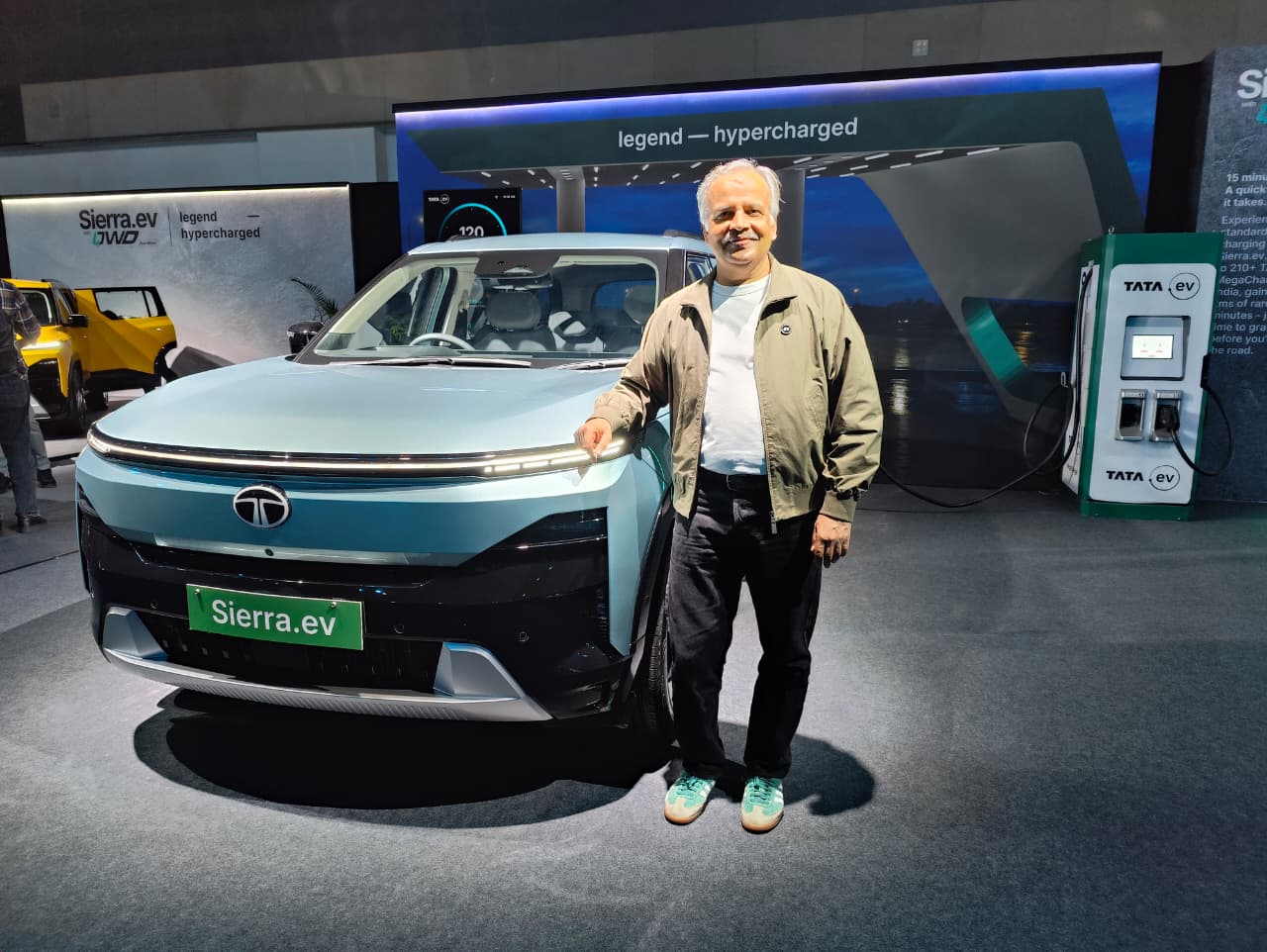
Mr. Anand Kulkarni, Chief Product Officer, Head of High Voltage Projects and Customer Care, Tata Electric Passenger Vehicles
Tata engineers didn’t just put batteries into SUVs. They rethought the entire car from the ground up, and the result is the fastest Indian-made electric car to date.
Here’s a tricky problem that most people never consider: A car needs to deform slightly in a crash to protect everyone inside. But it also requires a large, heavy, rectangular battery somewhere. It still had to seat five people comfortably and have enough room underneath to handle rough roads. This was exactly the conundrum Tata engineers faced while building the Sierra EV. Their answer is not to make everything bigger or harder. Use every bit of space wisely.
The Sierra’s wheelbase is 2,730mm, which is quite roomy for a 4.3m car. But extending the wheelbase is just the first step. The harder question is how to squeeze the maximum number of batteries into that space without turning the car into a death trap in a crash. Mr. Anand Kulkarni, Chief Product Officer and Head of High Voltage Programs and Customer Care, Tata Passenger Cars Electric Vehicles, said the answer is to “disperse the impact forces in three different directions: under the car, A on either side of the windshield columns and rack-and-pinion steering. By spreading impact loads rather than transmitting them through the battery, engineers avoid the hassle of adding heavy reinforcements along the length of the battery, which means more space for the actual battery, and you have to be very precise so that no additional reinforcement is needed along the entire length of the battery.”
The battery itself is packaged in a cell-to-pack design — skipping the intermediate module layer used in most battery packs — to deliver an energy density of 141 Wh/kg. That’s a meaningfully high value for a vehicle of this size, and it goes directly to the Sierra’s range-core 75 kWh capacity.
Electric vehicles are generally heavier than gasoline vehicles, which tends to impair performance. “However, the Sierra EV is around 200kg lighter than the Harrier EV. This weight advantage, combined with the lower location of the battery and near-perfect 50:50 weight distribution over all four tires, translates directly into driving feel. The result is a 0-100km/h acceleration time of 5.8 seconds, making it the fastest Indian-made electric car on sale today, and evidence of the kind of solid handling typically associated with more expensive cars. “When Tata pulled a stock plug-in straight off the production line, unmodified, and sent it onto the desert dunes, it succeeded,” Mr. Kulkarni said.
Range isn’t just about battery size, though. The Sierra EV quietly incorporates several efficiency measures that most buyers will never notice. Brushless DC motors for front cooling fans consume less power than conventional motors. An electronically controlled expansion valve – ETXV – optimizes the flow of refrigerant between the battery and cab according to demand at a given moment. The passive integrated heat exchanger reduces the pressure in the AC condenser, making the compressor work easier, without consuming electricity, just smarter thermodynamics. Add a fully optimized flat underbody for cleaner airflow, refined regenerative braking and improved throttle response, and it all adds up to a MIDC-certified range of 665km. He explained that in real-world driving, this number stabilizes at a reliable 500 kilometers or more.
TOLL
Recharge keeps pace with these ambitions. At 1.6C between 20% and 80%, the Sierra can regain approximately 300 kilometers of practical range in approximately 25 minutes. To put it in perspective: a run from Pune to Bangalore means only one stop, which takes about as long as a cup of coffee and a quick bite to eat. Mr Kulkarni’s contention is that this should be the only car a family needs – not a second electric car for use in the city alongside a petrol car on the highway, but a car that can handle everything seamlessly.
Safety
Safety also goes beyond the star rating. Mr. Kulkarni calls it Integrated Safety Management, and the idea is that the car reacts to what’s going on around it, not just to a collision that has already occurred. Picture this: Your car automatically brakes to avoid hitting a stationary truck ahead. The driver behind you didn’t react in time and hit your car from behind, pushing you toward the truck. The Sierra detects a second reduction in its front clearance and brakes again to cushion the secondary impact. At the same time, it pre-inflates the airbags to protect the driver’s chest and face, and automatically makes an SOS call to emergency personnel after a collision. He emphasized that this is a system designed for how accidents actually occur in the real world, rather than just modeling accidents in laboratory tests.
Inside, the engineering precision continues. The team carefully balanced the front and rear overhangs to maximize cabin space while maintaining enough shoulder room so five adults don’t feel like they’re sitting in a tumble dryer. He mentioned that the Z-axis (ground clearance, battery height, floor thickness, seat height) was equally carefully stacked to keep occupants high enough for easy entry and exit without pushing up the roofline and ruining the car’s proportions.
In terms of materials, he says high-strength steel is used where the structure requires it, soft-touch surfaces cover everywhere where hands naturally land, and a large proportion of interior plastic trim uses recycled materials – without any obvious compromises in appearance or durability. It’s a small detail, but it embodies the same basic philosophy that runs throughout the car: do more with less, more carefully.