
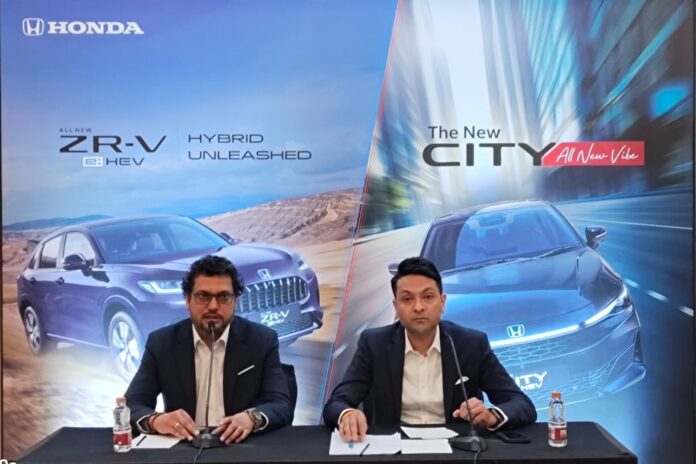

Honda Cars India is embarking on its most ambitious product offensive in years. There will be six launches this calendar year, two of which have already been launched. The highlight – an electric SUV measuring over four meters – will be launched in the second half of this financial year. The vehicle was showcased to a global audience at the Japan Mobility Show and has been undergoing road testing in India since April.
Mr. Kunal Behl, Vice President, Marketing and Sales, Honda Cars India Ltd. said that as part of its preparations for the launch of electric vehicles, the company is currently building a charging ecosystem around it, partnering with multiple charge point operators instead of investing in its own charging infrastructure.
Electric cars don’t exist in isolation. The OEM has announced plans to launch more than a dozen products in India by 2030, with a clear focus on the SUV segment. A sub-four-meter SUV has been confirmed for launch in 2028, with multiple powertrain options, and at least one more SUV over four meters is also planned. He said the reason is that the five-year compound annual growth rate of the sub-4-meter and above-4-meter SUV segments both exceeds 20%, while the hatchback segment shrinks by about 4% annually. Honda has identified where the market is going and is positioning itself accordingly.
When it comes to powertrains, Honda prefers hybrid over turbocharging as the hybrid system offers performance comparable to that of a turbocharged engine, with the city hybrid producing 253 Nm of torque while offering significantly higher efficiency. The new hybrid engine will be launched globally by 2027 and India is expected to benefit from it. When it comes to electric vehicles, the automaker is taking a collaborative approach – seeking technology and resource partnerships to reduce development time and costs and stay competitive in a market where domestic players are offering feature-rich products at aggressive prices.
He acknowledged that Honda’s current market share of about 1.3% to 1.4% reflects the segments and powertrains it chooses to participate in, rather than a measure of the quality of its products. In the pure gasoline segment of the Elevate category, the company holds about 5% stake. The company does not pursue market share targets. Instead, it believes that as the product lineup expands into segments where it has not previously competed, share will follow naturally.
Automatic transmissions currently account for 52% of Amaze sales, 61% of City sales and 72% of Elevate sales. Indian buyers are increasingly focusing on value rather than price, looking for features, driving pleasure and a powertrain that suits their needs. After years of operating in a relatively tight space, Honda is now gearing up to enter the market more ambitiously – and the next few years will tell whether that strategy works.
Supporting the product rollout is Honda Financial India, a wholly-owned subsidiary of Honda established last year. It is expected to start its consumer financing business this financial year, offering solutions such as lower EMIs and one-time payment options. The focus, Bell explained, is Honda’s huge two-wheeler loyalists looking to upgrade to four-wheelers, and these buyers need flexible financing to make the switch.
Manufacturing is currently concentrated at the Tapukara plant in Rajasthan, which has an installed capacity of 180,000 units and a utilization rate of 60% to 75%. The Greater Noida plant was closed in 2020 and has yet to resume production. The company will evaluate expansion options as sales grow, but has not yet committed to specific plans.
Tamil Nadu leads the way
According to him, Tamil Nadu is Honda’s strongest market in India, ranking sixth in the entire industry in the country, but Honda ranks first – this is due to the state’s strong preference for petrol and CVT cars, which perfectly matches Honda’s product advantages. Passenger car penetration in Tamil Nadu stands at 250 vehicles per 1,000 people, while the national average is only 34 vehicles per 1,000 people. Honda is currently deepening its presence in tier-II and tier-III towns in the south, where growth rates are 22 to 24 per cent compared to large cities.
Digitization
Digitally, the entire sales and service channel is now online – from booking and payment to test drives and service appointments. AI-assisted call centers operate around the clock, and AI is also used in sales team training. Digital infrastructure is crucial, he said, adding that its systems have advantages over other manufacturers in terms of ease of navigation and customer experience, he concluded.