
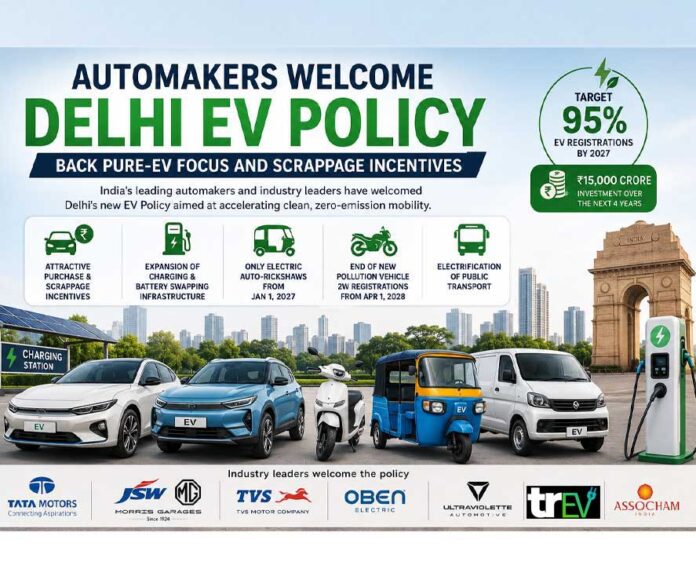

India’s leading automakers and electric mobility companies have welcomed the Delhi government’s new electric vehicle (EV) policy, lauding its emphasis on battery electric vehicles (BEVs), scrappage-linked incentives and expanded charging infrastructure. Industry leaders believe this policy will lead the national capital towards clean, zero-emission mobility while setting a benchmark for other states.
The Delhi Cabinet has approved the new EV policy with the ambitious goal of ensuring that 95% of all new vehicle registrations in the city are electric by 2027. The policy, which will come into effect from July 1, also proposes an investment of about ₹15,000 crore over the next four years to strengthen Delhi’s EV ecosystem.
Tata Motors supports pure-EV strategy
Tata Motors Passenger Vehicles Limited described the policy as an important step towards strengthening India’s EV ecosystem by providing long-term policy certainty.
“Delhi has once again demonstrated leadership in doing the right thing. By maintaining ambitious electrification timelines for high-use vehicle segments and focusing policy incentives on pure EVs, the government has reinforced the principle that public support should leverage and accelerate technologies that provide maximum environmental benefits with zero emissions,” the company said.
The automaker said the policy provides long-term direction for the industry, strengthens confidence in India’s EV ecosystem, and can serve as a benchmark for other states pursuing clean urban mobility.
Attractive purchase and scrappage incentives
The policy provides incentives related to purchase and scrappage of passenger vehicles, two-wheelers, three-wheelers and light commercial vehicles.
Eligible buyers purchasing an electric passenger vehicle worth up to ₹30 lakh after scrapping the eligible old vehicle can avail an incentive of up to ₹1 lakh. Electric cars will also continue to be exempted from road tax and registration fees.
Electric two-wheelers will be eligible for purchase incentives of up to ₹30,000 during the first year, with the benefits gradually reducing in subsequent years. Buyers scrapping eligible old two-wheelers will get additional incentives.
Electric three-wheelers will be eligible for incentives of up to ₹50,000 in the first year, while scrappage benefits will also be available for replacing old auto-rickshaws. Eligible electric light commercial vehicles (e-LCVs) may get incentives of up to ₹1 lakh.
Travel Mobility highlights shared mobility opportunity
Commenting on the new policy, Naveen Gupta, Founder and CEO, Travel Mobility, said Delhi’s latest EV infrastructure is an important milestone in India’s clean mobility journey.
“Delhi’s new EV policy is an important step towards accelerating the transition from traditional fuel-based mobility to cleaner, more sustainable transport. Incentives for electric vehicles, fleet electrification and a focus on reducing dependence on traditional fuels reflect the growing need for structural change in how cities move.”
Gupta said fleet electrification has the potential to significantly reduce urban emissions and improve air quality, but stressed that successful adoption requires more than simply replacing internal combustion engine vehicles with EVs.
According to him, charging infrastructure, efficient vehicle usage, driver adoption, financing support and consumer confidence are equally important to build a sustainable shared mobility ecosystem.
“The next phase of EV mobility will require operators to think beyond replacing an internal combustion engine vehicle with an electric one. It will be about creating reliable, convenient and experience-based mobility solutions that make electric transportation a natural choice for consumers.”
He said that while government policies provide the necessary incentives, meaningful change will only come through collaboration between industry players, technology providers and mobility operators.
“India’s mobility future will not be defined just by how many EVs are sold, but by how effectively we integrate electric vehicles into daily life through shared and accessible mobility models.”
JSW sees MG Motor India policy as a model for other states
JSW MG Motor India Managing Director Anurag Mehrotra described the policy as a positive step towards clean mobility and reducing dependence on imported crude oil.
“This is a step in the right direction towards improving air quality, promoting cost-effective travel and protecting national interests by reducing dependence on crude oil. Incentives for scrapping old vehicles and replacing them with new EVs is also an important measure, as poorly maintained old vehicles are among the major contributors to vehicle pollution.”
He said Delhi’s EV policy can serve as a pilot project for other states, providing valuable lessons for wider adoption across the country.
ASSOCHAM welcomes investment of ₹15,000 crore
Assocham President Nirmal K. Minda said the proposed ₹15,000 crore investment demonstrates the scale of commitment required to accelerate Delhi’s clean mobility transition.
“The proposed investment towards strengthening the EV ecosystem, including charging infrastructure and incentives, reflects the scale of commitment required to accelerate the clean mobility transition.”
He said this policy has the potential to significantly reduce vehicle emissions while creating new economic opportunities and can serve as a model for other states.
TVS Motor described the policy as future-oriented
TVS Motor Company Chairman Sudarshan Venu welcomed the policy, calling it proactive and future-focused.
“We welcome the new EV policy of the Delhi government, which is proactive and forward-looking. We are fully committed to developing sustainable mobility products and solutions to drive EV adoption.”
Oben welcomes electric two-wheeler Focus
Madhumita Agarwal, Founder and CEO, Oben Electric, said Delhi’s EV Policy 2.0 addresses the key enablers required to accelerate large-scale EV adoption.
“Delhi’s EV Policy 2.0 is a progressive policy that addresses the key enablers required to accelerate large-scale EV adoption. By combining a clear roadmap for the transformation of the two-wheeler segment with continued consumer incentives, expansion of charging infrastructure and long-term ecosystem investments, the policy provides the necessary clarity and confidence for both consumers and the industry.”
He highlighted that motorcycles represent India’s largest personal mobility segment and therefore offer the greatest opportunity for large-scale electrification.
Aggarwal said the policy puts a greater onus on manufacturers to deliver electric motorcycles that can match conventional motorcycles in terms of performance, reliability, safety and ownership experience.
He also said that a visionary policy framework will play a key role in promoting long-term investment, accelerating innovation and strengthening India’s position as a global EV leader.
Praises Ultraviolet Charging Push
Narayan Subramaniam, CEO and design head, Ultraviolette Automotive, welcomed the government’s commitment to an all-electric two-wheeler future.
“We welcome Delhi’s commitment to an all-electric two-wheeler future by 2028. Price-agnostic consumer support matters because it doesn’t penalize buyers who want more from their machine – whether in terms of range, technology, performance or design. The emphasis on charging infrastructure ultimately treats energy as part of the product rather than an afterthought. Clean technology is the way forward, and at Ultraviolette we’re making that shift exciting Are.”
Focus will be on pure electric vehicles
The new policy continues to prioritize battery electric vehicles (BEVs), reaffirming Delhi’s commitment to zero-emission mobility by excluding strong hybrid vehicles from the incentive schemes.
Beyond financial incentives, the policy proposes significant expansion of public and private charging infrastructure, battery charging and swapping networks and electrification of public transport. These initiatives are part of the government’s proposed ₹15,000 crore investment program that aims to strengthen the city’s EV ecosystem over the next four years.
The policy also outlines a phased roadmap to electrify high-usage vehicle segments. Only electric auto-rickshaws are expected to be registered in Delhi from January 1, 2027, while registration of new petrol, diesel and CNG-powered two-wheelers is proposed to end from April 1, 2028.
The Delhi government has been working on a successor to its 2020 EV policy for several months, with a focus on charging infrastructure, fleet electrification and a revised incentive framework.
With a clear long-term roadmap, strong fiscal incentives and a continued focus on pure electric vehicles, the New Delhi EV policy aims to position the national capital as one of India’s leading electric mobility hubs, while serving as a model for cleaner and more sustainable transportation for other states.