
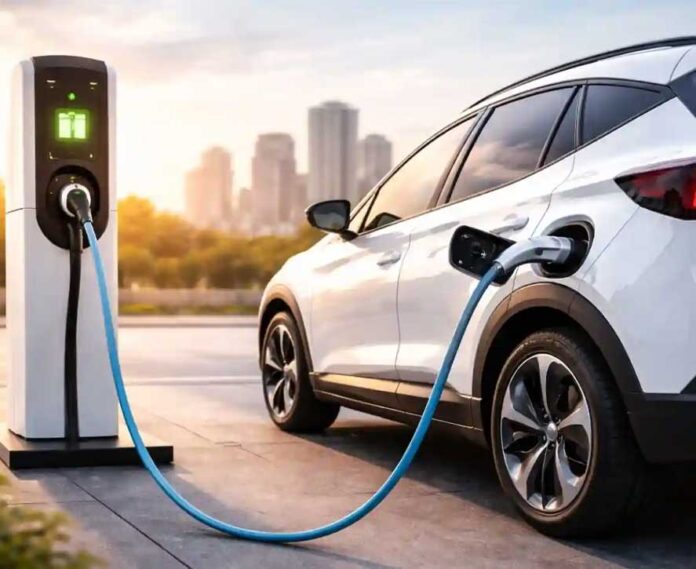

The Delhi Cabinet has approved the capital’s new electric vehicle (EV) policy, which will see an investment of around ₹15,000 crore over the next four years to accelerate the shift towards electric mobility in the city. The policy, which will come into effect from July 1, aims to strengthen Delhi’s EV ecosystem through expanded charging infrastructure, public transport electrification, consumer incentives and long-term ecosystem development.
Announcing the decision after a cabinet meeting, Chief Minister Rekha Gupta said the policy is designed to establish Delhi as one of India’s leading electric mobility hubs while significantly increasing EV adoption across vehicle sectors.
The government has set an ambitious target of ensuring that 95% of all new vehicle registrations in the national capital are for electric vehicles by 2027.
₹15,000 crore investment to strengthen EV ecosystem
The highlight of the new policy is the proposed investment of approximately ₹15,000 crore over the next four years. The investment will be directed towards expanding public and private charging infrastructure, developing battery charging and swapping networks, electrifying public transport and strengthening the overall EV ecosystem.
While the government has announced the overall investment commitment, detailed allocations across various programs including charging infrastructure, incentives and public transport are expected to be specified in the official notification.
The Delhi government is also expected to issue detailed implementation guidelines outlining the eligibility criteria, timelines and operational framework for various incentives and initiatives under the policy.
Purchase and scrappage incentives across all vehicle segments
The new EV policy introduces purchase and scrappage-linked incentives in passenger vehicles, two-wheelers, three-wheelers and light commercial vehicles to encourage faster adoption of electric mobility.
Eligible buyers purchasing an electric passenger vehicle worth up to ₹30 lakh after scrapping the eligible old vehicle can avail an incentive of up to ₹1 lakh, subject to the terms of the policy. Electric passenger vehicles will continue to benefit from exemption from road tax and registration fees, thereby reducing the total ownership cost.
Electric two-wheelers will be eligible for a purchase incentive of up to ₹30,000 during the first year of the policy, with the incentive gradually reducing in subsequent years. Buyers replacing eligible old two-wheelers with electric models will also be eligible for additional scrappage incentives.
Electric three-wheelers will get a purchase incentive of up to ₹50,000 during the first year, along with scrappage benefits for replacement of eligible old auto-rickshaws. Eligible electric light commercial vehicles (e-LCVs) may get incentives of up to ₹1 lakh.
Focus on infrastructure and long-term development
Beyond consumer incentives, the policy emphasizes the development of infrastructure needed to support large-scale EV adoption.
The proposed investment program includes expanding charging infrastructure, setting up battery charging and swapping facilities, electrifying public transport and creating a strong ecosystem capable of supporting the continued growth in electric mobility across Delhi.
The government is expected to issue a comprehensive notification detailing the implementation roadmap, infrastructure rollout plans and timelines for various initiatives.
Phased Roadmap for Clean Mobility
The policy also outlines a phased transition towards clean transportation in high-usage vehicle segments.
Under the proposed roadmap, only electric auto-rickshaws are expected to be registered in Delhi from January 1, 2027. Additionally, new registrations of two-wheelers running on petrol, diesel and CNG are proposed to end from April 1, 2028.
The revised framework continues to prioritize battery electric vehicles (BEVs) and does not provide financial incentives to strong hybrid vehicles, strengthening the government’s commitment to zero-emission mobility.
Building on Delhi’s 2020 EV policy
The newly approved policy replaces Delhi’s 2020 EV policy, one of the earliest state-level electric vehicle policies in India. The earlier framework played a key role in promoting EV adoption by offering purchase incentives, rebates on road tax and registration fees and support for charging infrastructure, helping Delhi to be among the leading electric mobility markets in the country.
The Delhi government had been working on the revised policy for several months, which discussed expanding charging infrastructure, accelerating fleet electrification, strengthening the broader EV ecosystem and refining the incentive framework. The 2020 policy was extended several times while the new framework was being finalized before getting Cabinet approval.
Industry awaits detailed notification
Now with Cabinet approval, vehicle manufacturers, charging infrastructure providers, fleet operators and component suppliers are expected to closely monitor the government’s detailed notification, which will provide clarity on implementation timelines, eligibility criteria, incentive structures and programme-specific allocations.
Combining substantial infrastructure investment, attractive consumer incentives and a clear regulatory roadmap, Delhi’s new EV policy represents one of India’s most ambitious state-level electric mobility initiatives and is expected to play a key role in accelerating the capital’s transition towards cleaner and more sustainable transport.