
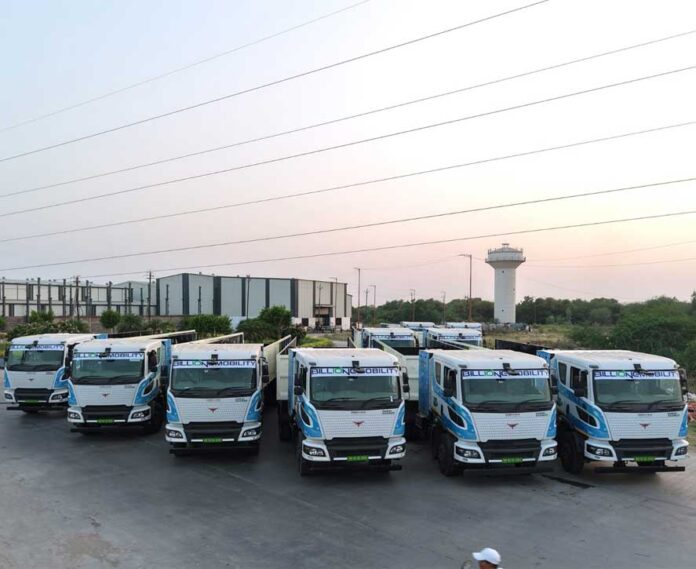

JK Lakshmi Cement has completed the deployment of 70 electric vehicles (EVs) as part of its transformation towards sustainable logistics, with the company targeting a fleet of 120 EVs by March 2027.
The cement maker has also achieved almost 100% electric vehicle-based clinker dispatch from its Sirohi plant in Rajasthan to its Kalol grinding unit in Gujarat.
This initiative highlights JK Lakshmi Cement’s efforts to accelerate the adoption of electric mobility in long distance transportation within the cement industry. By electrifying its logistics operations, the company aims to reduce the environmental impact of freight transportation and further its sustainability objectives.
The company has deployed 70+ EVs on key transportation routes connecting Sirohi to its Kalol Grinding Unit, Palanpur Unit and Surat Grinding Unit. To support these operations, JK Lakshmi Cement is collaborating with specialized EV logistics providers Switchlabs and Billion E. Building on its existing deployment, the company plans to expand its EV fleet to 120 vehicles by March 2027.
Commenting on the initiative, Ms. Vineeta Singhania, Chairman and Managing Director, JK Lakshmi Cement, said, “At JK Lakshmi Cement, we are focused on integrating sustainable practices across our operations while ensuring long-term business efficiency. With a fleet of 70+ electric vehicles currently in our logistics network, we are making solid progress in adopting clean transportation solutions. The transition to EV-based clinker dispatch on the Sirohi-Kalol route is part of this This is an important milestone in the journey and reinforces our commitment to enhancing sustainable logistics as part of our broader decarbonisation strategy.
The EV deployment program is an integral part of the sustainability roadmap of JK Lakshmi Cement’s green logistics and decarbonization strategy, which aims to improve operational efficiency and reduce emissions across its value chain. Through the adoption of clean transportation solutions and other sustainability-based initiatives, the company is pursuing its long-term ambition to achieve net-zero emissions by 2047.