Tag: hero farewell

  • TVS, Bajaj, Ather lead India’s e-2W boom in April 2026; Ola Electric sold 12,000 units.

    TVS, Bajaj, Ather lead India’s e-2W boom in April 2026; Ola Electric sold 12,000 units.

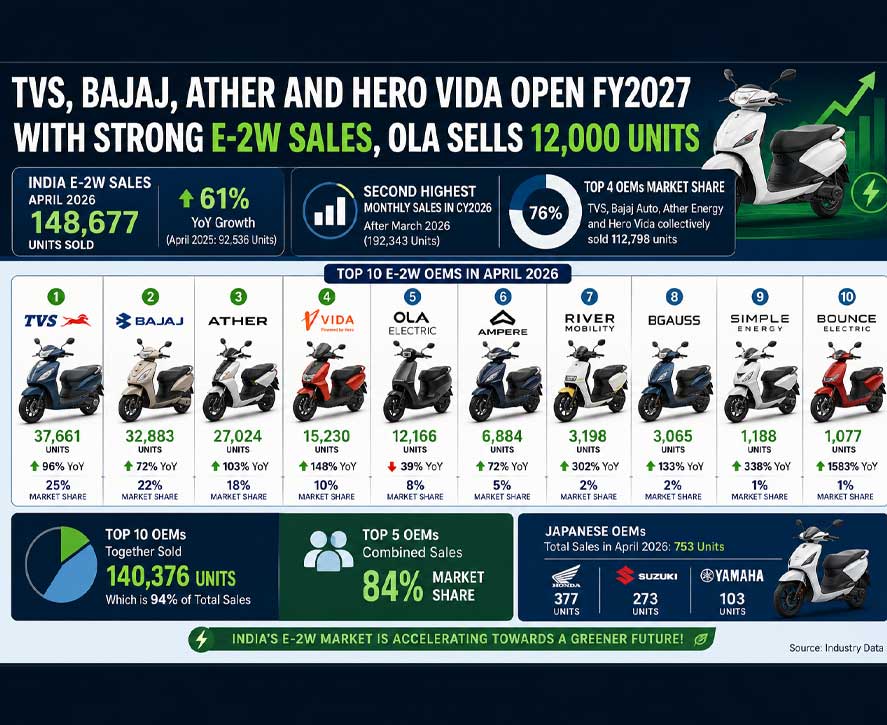
    India’s electric two-wheeler (e-2W) market has embarked on a high growth trajectory in FY2027 led by strong performance from TVS Motor Company, Bajaj Auto, Ather Energy and Hero MotoCorp’s Vida brand, while Ola Electric has reported monthly sales of over 12,000 units.

    After ending FY2026 with record retail sales of 1.40 million units, the industry maintained its momentum in April 2026, with total e-2W deliveries reaching 148,677 units – up 61% year-on-year (April 2025: 92,536 units). This is the second highest monthly sales figure so far in CY2026 after March’s 192,343 units.

    The top four OEMs – TVS, Bajaj Auto, Ather Energy and Hero Vida – collectively retailed 112,798 units, accounting for a dominant 76% share in the market.

    Market leader TVS Motor Company recorded sales of 37,661 units in April, marking a strong growth of 96% year-on-year and capturing 25% market share. The company’s growth is being supported by its Battery-as-a-Service (BaaS) strategy, which reduces upfront ownership costs and increases customer confidence. While the iQube remains its main volume driver, the new Orbiter range continues to gain popularity.

    Bajaj Auto took the second position with 32,883 units of its Chetak e-scooter, showing a growth of 72% YoY and gaining 22% market share. This is its third best monthly performance ever.

    In third place, Ather Energy recorded sales of 27,024 units, more than double its volume with a 103% year-on-year growth. The Bengaluru-based EV maker now has 18% market share and is moving towards the number 2 position.

    Hero MotoCorp’s Vida brand retained its fourth position with sales of 15,230 units in April, up 148% year-on-year, translating into 10% market share. The brand has grown rapidly and has crossed cumulative sales of 200,000.

    Meanwhile, Ola Electric remained at the fifth position for the second consecutive month with retail sales of 12,166 units. Although this represents a decline of 39% year-on-year, the company has shown signs of improvement with month-on-month sales improving.

    Greaves Electric Mobility (Ampere) took the sixth position with 6,884 units, up 72% year-on-year and accounting for 5% market share. The company recently strengthened its portfolio with the launch of Ampere Magnus Neo.

    Among emerging players, River Mobility, driven by demand for its Indie e-scooter, sold 3,198 units (up 302% YoY), while Bagos Auto sold 3,065 units, registering a growth of 133%.

    Simple Energy continued its upward trend with sales of 1,188 units, up 338% year-on-year, supported by its updated Gen 2 lineup and upcoming products.

    Bounce Electric entered the top 10 with 1,077 units and registered an extraordinary growth of 1,583% over a low base.

    Overall, the top 10 OEMs contributed a total of 140,376 units – accounting for 94% of total April sales – highlighting increasing consolidation in India’s fast-growing e-2W market. The top five players alone contributed 84% of the total volume, underscoring their continued dominance.

    In contrast, Japanese OEMs including Honda Motor Company, Suzuki Motor Corporation and Yamaha Motor Company collectively sold only 753 units during the month, indicating their limited presence in India’s electric two-wheeler sector.
  • Record of 1.4 million electric two-wheelers in India in FY 2026, capturing 57% of EV market.

    Record of 1.4 million electric two-wheelers in India in FY 2026, capturing 57% of EV market.

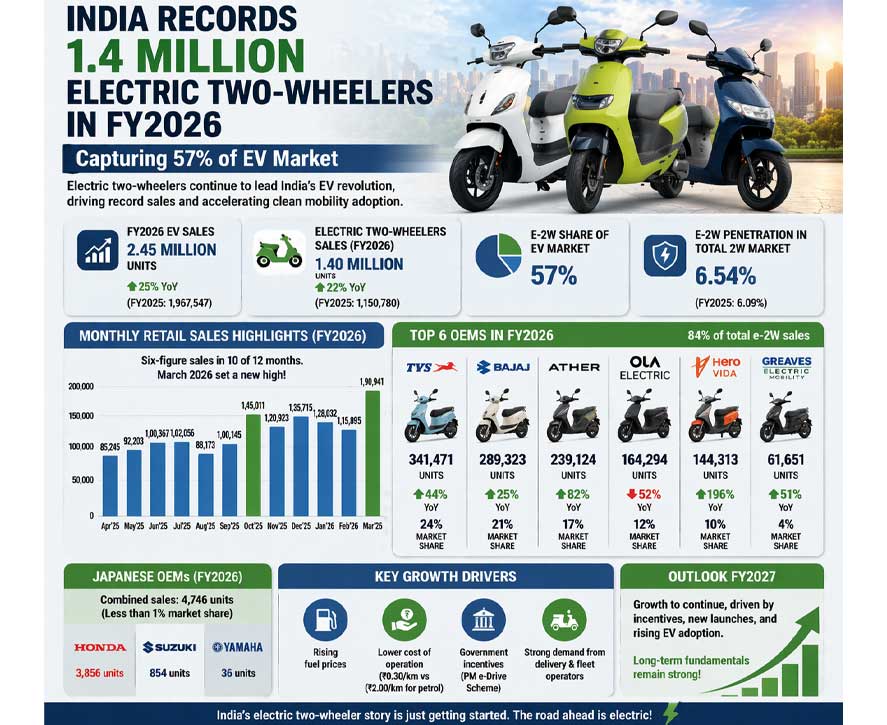
    FY2026 has emerged as a landmark year for India’s electric vehicle industry with total EV retail sales crossing 2.45 million units, showing a 25% year-on-year growth as compared to 1.97 million units in FY2025. This surge was primarily driven by the electric two-wheeler (e-2W) segment, which has dominated India’s EV landscape.

    According to Vahan portal data (April 1, 2026), 1.40 million electric two-wheelers were sold during FY2026, showing a growth of 22% from 1.15 million units in FY2025. This performance gave electric two-wheelers a 57% share of India’s total EV market, cementing their position as the backbone of India’s electric mobility transition.

    Despite the price gap between petrol and electric two-wheelers narrowing after the GST transition in September 2025, demand remains resilient. The penetration of electric two-wheelers in India’s total two-wheeler market increased to 6.54% in FY2026 from 6.09% in FY2025. Rising petrol prices, low operating costs and increasing model availability continued to attract buyers.

    The segment also benefited from growing demand in last-mile delivery, e-commerce and fleet operations, where low total cost of ownership (TCO) makes EVs particularly attractive. In particular, fleet operators are accelerating the adoption of electric vehicles due to their operational efficiency.

    Top Electric Two-Wheeler OEMs in FY2026

    The Indian e-2W market remained concentrated, with five manufacturers accounting for 84% of total sales. Among them:

    TVS Motor took the lead

    TVS Motor emerged as the new market leader in FY26, selling 341,471 units, up 44% year-on-year and capturing 24% market share. Strong demand for the iCube and Orbiter models along with the introduction of Battery-as-a-Service (BaaS) helped drive growth.

    Bajaj Auto reaches number 2

    Bajaj Auto took second position with 25% YoY growth to 289,323 units and 21% market share. The launch of Chetak C2501 contributed to its continued growth.

    Ather Energy records fastest growth

    Ather Energy recorded 239,124 units, marking 82% year-on-year growth and 17% market share. The Rizta family of scooters, which accounted for about 70% of sales, played a major role in the company’s expansion.

    Ola Electric is seeing a huge decline

    Former market leader Ola Electric experienced a significant decline, selling 164,294 units, down 52% year-on-year, reducing its market share to 12% and slipping to fourth place.

    Hero MotoCorp’s Vida surge

    Hero MotoCorp’s Vida brand posted 144,313 units, representing 196% year-on-year growth and capturing 10% market share. Strong demand for Vida VX2 drove this growth.

    Greaves maintains electric mobility position

    Greaves Electric Mobility ranked sixth with 61,651 units, up 51% year-on-year, supported by new product launches and growing demand.

    Japanese OEMs are struggling to gain popularity

    Japanese manufacturers Honda, Suzuki and Yamaha together sold only 4,746 electric scooters in FY26, highlighting the dominance of Indian manufacturers. Late entry, limited availability, and premium pricing contributed to its modest adoption.

    Growth drivers in FY2026

    Several factors accelerated the adoption of electric two-wheelers:

    PM e-Drive scheme incentives, rising petrol prices, expansion of charging infrastructure, growing fleet and delivery demand, wide product portfolio across all price segments, low operating and maintenance costs

    Electric two-wheelers typically cost ₹30 per kilometre, while petrol vehicles cost ₹2 per kilometre, making them increasingly attractive for both personal and business use.

    FY2027 Outlook

    While FY2026 has set a new benchmark, FY2027 growth will depend on:

    Extension or withdrawal of government incentives, global oil price trends, new product launches, expansion into tier-2 and tier-3 markets.

    Despite the uncertainties, strong fundamentals of low ownership costs, environmental benefits and growing consumer awareness suggest continued growth for India’s electric two-wheeler market.

    India’s E-2W industry has demonstrated flexibility and momentum and firmly established electric mobility as a mainstream transportation option in the coming years.