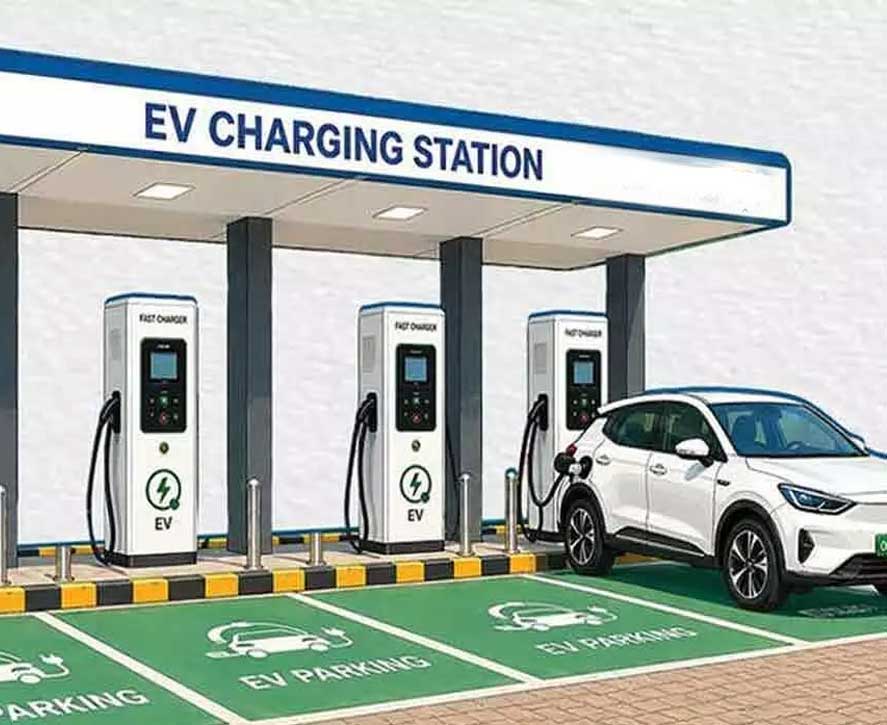
As India accelerates the transition to electric mobility, rapid expansion of EV charging infrastructure has become a key priority. Although the country now has more than 52,700 public charging stations, including 16,561 fast chargers, access to charging is considered one of the biggest barriers to widespread EV adoption.
This apparent contradiction highlights a more fundamental issue. The challenge is no longer just about installing more charging stations – it is about ensuring they can be delivered efficiently and in a timely manner.
In this opinion, Sumit Kumar, Founder and Director, Headsup B2B Pvt Ltd, argues that the real disruption lies upstream in the value chain. From procurement and supplier financing to planning and supply chain coordination, he explains why strengthening these foundational processes is essential to accelerate India’s EV charging infrastructure rollout.
Charging stations are a supply chain, not a product
Each site is an assembly: transformers, switchgear, cables, EVSE controllers, DC power modules, storage and, increasingly, rooftop solar. One late component holds the entire site hostage. Commissioning slips, leases keep rolling, the financing clock doesn’t stop.
Many of these components are import dependent – liquid-cooled cables, high-power DC modules, controller boards, advanced power electronics. Import dependence is lead-time instability by another name. Developers absorb this by creating buffers, and buffers are the costs that ultimately appear in the per unit tariff.
The real bottleneck is in the working capital of the sellers
In infrastructure procurement, manufacturing capacity is rarely the limiting factor. The real bottleneck is working capital. A medium-sized manufacturer of switchgear or cable may have the capacity to produce the necessary equipment, but financing the order for 90 days while waiting for the developer to pay may strain cash flow. Taking additional orders during that period becomes even more challenging.
As a result, suppliers are forced to prioritize customers who offer quick payment, extend lead times for others, or, in some cases, reject new orders altogether. What developers often view as a supply shortage is, in fact, a financing gap reflected in delayed deliveries rather than a lack of manufacturing capacity.
That’s why payment terms, not unit price, are the most leveraged variable in EV infrastructure procurement today. Move a vendor from a 60-90 day cycle to next day settlement and their effective capacity for you will increase manifold without a single new machine on the floor. In Headsup B2B, embedded channel finance settles sellers at T+1 while buyers maintain their credit terms. Supply response is immediate, and it is reflected in delivery commitments before it is visible elsewhere.
Purchasing is a capability, not a function
Fragmented supplier databases, manual sourcing and disconnected project tracking cannot meet the complexity of a national charging rollout. What makes consolidation work: A verified seller network, transparent price discovery, live order visibility, and financing built into the transaction, not next to it.
Done properly, this layer is property-light. It does not own the inventory or build the project. This removes the burden of coordination from the people doing this. The benefits are shorter procurement cycles, enforceable vendor accountability and really low execution risk.
Flexibility now matters as much as cost
Recent disruptions have made this abundantly clear: geopolitical shocks, raw material surges and logistics disruptions cause project delays in a single quarter. Two things build stability against that.
First, predictive planning. Demand patterns, supplier performance history and early risk flags let developers secure critical equipment before it is needed, rather than bidding against everyone else at the point of shortage.
Second, localization. Expanding domestic manufacturing of chargers, transformers, switchgear and power electronics reduces lead times and cuts currency and freight risks. The policy has laid the foundation. Converting this to installed capacity requires manufacturers with working capital to invest – which raises the argument about how and how fast the supply base is repaid.
spinal cord issue
India will not lack ambition on charging infrastructure, or capital, or policy support. It may lack the sourcing and settlement infrastructure that turns all three of these into commission assets.
Someone has to be the backbone: verifying vendors, researching pricing, moving materials, and paying the supply base fast enough to maintain it. That layer is unglamorous and decisive. The next phase of India’s EV story will be written less in charge point counts than in the quality of the procurement systems parked behind them.