
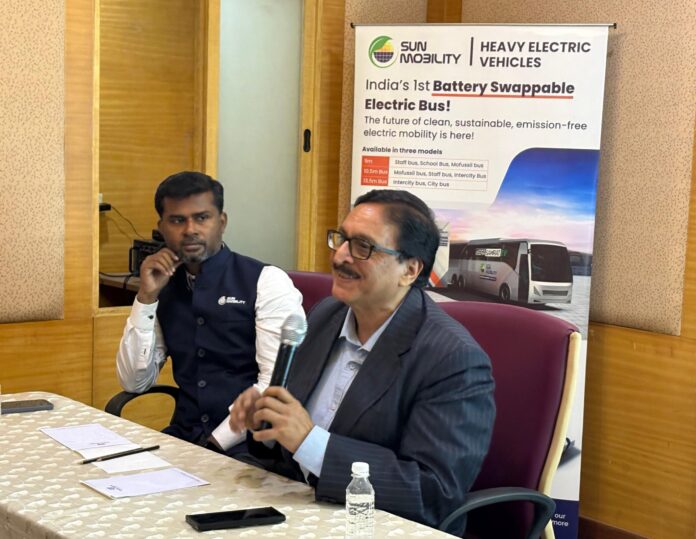

SUN Mobility, a leading provider of electric vehicle (EV) energy infrastructure and services, showcased India’s first modular battery swapping technology for heavy-duty electric vehicles (HEVs) at an event in Chennai. More than 100 private bus operators and operator associations from across Tamil Nadu participated in the event.
SUN Mobility, in partnership with leading bus manufacturer Veera Vahana, recently showcased a fully integrated mobility solution aimed at electrifying bus and truck fleets at Prawaas 4.0, an international conference organized by Bus and Automobile Operators Confederation of India (BOCI). This technology solution highlights the urgent need to electrify commercial fleets, especially heavy-duty vehicles, which is critical to reducing emissions, improving air quality and increasing the overall efficiency of the transportation sector. The event attracted over 10,000 inquiries for buses and subsequent workshops were mainly targeted at bus operators in Tamil Nadu. At the seminar, details of SUN Mobility’s products and cost-benefit analysis were highlighted. Additionally, it is discussed how this solution meets bus operators’ expectations to move to cleaner fuels with a similar cost structure and refueling experience to existing diesel buses.
During the event, SUN Mobility signed a memorandum of understanding with several of the region’s leading bus operators, highlighting the game-changing potential of battery swapping technology in the electrification of heavy vehicles.
Ashok Agarwal, CEO of SUN Mobility HEV, said: “SUN Mobility transforms HEV by solving key challenges faced by bus operators, including high cost of ownership, limited financing options, extended downtime due to long charging times and the burden of deploying charging infrastructure. Our modular switching technology provides a practical, cost-effective solution that improves operator efficiency and reduces operating costs.”
The battery replacement will reduce the upfront cost of the buses by 40%, making them comparable to the upfront costs of traditional ICE buses, which, coupled with easy access to financing, will break down barriers to entry for fleet owners to adopt electric vehicles. Additionally, it can reduce operating costs for fleet operators by up to 20%, while increasing bus uptime and higher utilization due to a quick swapping process within three minutes. The mofussil operation has a unique use case in Tamil Nadu where the trip frequency is very high with buses making 6 to 8 trips in 1 day (16 hours of operation) where there is a gap of 2 to 10 minutes between buses traveling on a route. This type of operation is not possible for stationary battery vehicles that require at least 3 hours of charging. Battery swapping can provide the right solution for these operations. The battery is compact and lightweight, ensuring higher payload capacity.
Today, buses and trucks account for about 5% of the vehicle fleet but account for about 50% of tailpipe emissions. 90% of the commercial vehicle sector is privately owned and given the cost sensitivity of the sector, battery replacement can boost the adoption of electric vehicles and play a vital role in the widespread adoption of electric buses.
Since its inception in 2017, SUN Mobility has carried more than 26,000 vehicles in the two-wheel, three-wheel and small four-wheel fleet segments. The company has more than 650 battery swap stations across the country, drives approximately 1.6 million kilometers every day, and replaces batteries 60,000 times. Usage has increased by an impressive 84% compared to last year. Through its recent strategic joint venture with IndianOil, SUN Mobility brings together the power of IndianOil’s nationwide network of over 37,000 petrol stations and equips them with SUN Mobility’s unparalleled battery swapping technology, making it as convenient as traditional petrol stations. As such, it will simplify customers’ EV experience by conveniently delivering Battery as a Service (BaaS) across the country and alleviate concerns around battery costs, battery end-of-life, maintenance, replacement and charging times.