
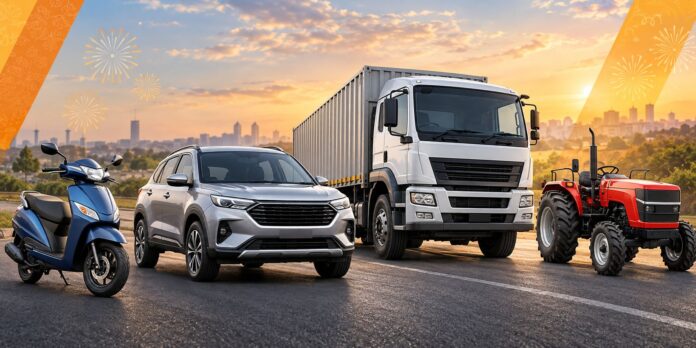

September 2026 is a memorable month for the Indian automobile industry. With the festive season just around the corner, demand is increasing in almost all segments, from scooters and family cars to heavy-duty trucks and electric buses. Several companies posted their best-ever monthly or quarterly results, helped by stable economic activity, strong infrastructure spending and the enduring momentum of last year’s GST 2.0 reforms. Greener options like electric vehicles and compressed natural gas are also playing a bigger role than ever before. Here’s how things look this month.
Passenger car
Market leader Maruti Suzuki set the tone by selling 236,013 units in September, up about 24%, while domestic passenger car sales jumped about 37% to 181,838 units. Utility vehicles increased by approximately 62% to 78,911 units, and passenger vehicles increased by 24%. Export volume increased by about 5% to 44,219 units. From April to September, Maruti’s total sales increased by about 28% to 1,379,378 units.
Tata Motors’ passenger car division had its best-ever quarter with 201,723 vehicles sold in July-September, a growth of 40%. In September alone, sales exceeded 70,000 vehicles for the first time. Tata’s story is a green one, with sales of electric vehicles soaring 90% in the quarter to a record 47,150 units, with electric vehicles now accounting for 23% of its sales, nearly three times the industry average. Together with CNG, the greener powertrains account for more than half of Tata’s sales. Its Punch was the best-selling SUV in India during the quarter.
Mahindra & Mahindra kept its SUV engines running, with domestic SUV sales rising 14% to 64,092 units and total sales rising 15% to 114,874 units. The company’s electric SUV sales also exceeded 100,000 units. The only weakness was exports, which fell by 7%.
Hyundai and Kia both broke their own records. Hyundai Motor sold 77,916 vehicles, its highest monthly sales in history, up 10.8%, with domestic sales and export growth almost flat. Kia went even further in terms of percentages, with sales rising 41% to 32,017 units, its best month since entering India, with the Seltos and Sonet leading the way.
Among small players, Toyota Kirloskar Motor has sold 28,218 units, up 8% so far this year. Nissan had a pleasant surprise this month, doubling domestic sales to 3,300 units with its new Tekton SUV, while exports still accounted for the bulk of its sales, with 6,725 units.
two wheeler
India’s two-wheeler manufacturers have a lot to celebrate. Honda’s motorcycle and scooter sales in India in September were 706,000 units, an increase of 24%, of which domestic sales increased by 26%. Sales in the first half of the year increased by 15% to 3.44 million vehicles.
TVS motors are keeping up with this pace. Its September sales rose 24% to 672,790 vehicles, and quarterly sales rose 27% to 1.9 million vehicles. Electric scooters and motorcycles were a bright spot, with sales of electric vehicles more than doubling to 65,799 units in September. Exports surged by 48% and three-wheelers increased by 57%.
Royal Enfield sold 1,33,958 motorcycles, its best month ever, a growth of 8%. In the first half of the year, thanks to the launch of new models such as the Himalayan 440, sales increased by 20% to more than 700,000 units. Suzuki motorcycles in India also grew 8% to 1,33,688 units, with exports surging 41%, although domestic growth remained modest at 3% off a high base.
commercial vehicle
The commercial vehicle segment shows how busy the Indian economy is. Tata Motors sold 1,35,114 commercial vehicles in the July-September quarter, a growth of 42.7%, with sales in September rising by 42.4% to 51,062 units. Heavy trucks grew by more than 40%, and international business nearly tripled.
Ashok Leland tells a similar story. Its sales rose 28% to 24,049 units, driven by infrastructure and freight demand, with domestic medium- and heavy-duty truck sales rising 44%. Passenger cars are an area of concern, with domestic passenger car sales down 6% so far this year despite a good performance in September. Mahindra’s truck and bus business grew 53% to 2,912 units, with cargo vehicles growing 84%.
In terms of electric buses, JBM Auto continued to maintain its leading position, registering 274 electric buses in September, with a market share of 33%. In the first half of this year, it held about 24% of the market.
tractor
On the farm, Sonalika Tractors has crossed one hundred thousand tractor sales in just six months, a milestone that took a full year to reach eight years ago. To meet festive demand, the company also achieved a record monthly production of 19,000 tractors.
The road ahead
September provides a strong launchpad for the industry’s festive season. SUVs, electric cars, trucks and two-wheelers are all moving in the right direction, with many companies saying their order books are in good shape. Rising fuel and commodity costs and a higher base in the coming months are likely to slow growth.