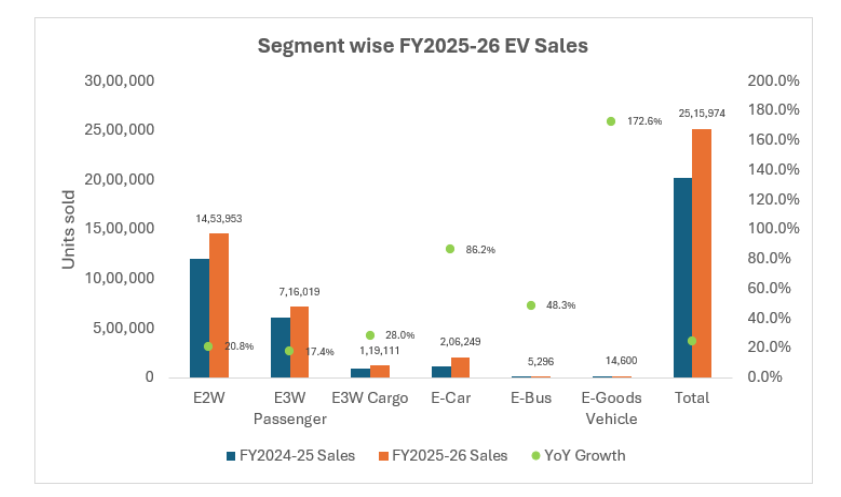
The Indian electric vehicle (EV) market performed strongly again in the financial year 2025-26, with total registrations exceeding 2.5 million units, a year-on-year growth of 24%. Electric vehicle penetration accounts for about 8.5% of total registrations, up from 7.7% in the previous fiscal year. While this reflects steadily strengthening EV adoption, the market remains below the government’s long-term target of 30% EV penetration by 2030.
Although the market is price sensitive, there are significant differences in growth drivers across segments:
• Electric two-wheelers (E-2W): remain the largest contributor accounting for nearly 58% of total EV sales.
• Electric Three-Wheeler – Passenger Transport (E-3W P): The passenger transport market peaked at 78,057 units in December 2025, with mandatory registration of e-rickshaws in West Bengal becoming the major driver. However, sales have slowed down after December 2025 due to exhaustion of PM E-DRIVE incentives for the L5 category.
• Electric Three-Wheeler – Cargo (E-3W C): The cargo category has seen steady growth, driven by the total cost of ownership (TCO) advantage of last-mile delivery fleets compared to the passenger segment.
• Passenger cars (electric vehicles): Becoming the fastest-growing market segment, with an impressive year-on-year growth of 86%. Notably, this growth is independent of PM E-DRIVE support, as electric vehicles are excluded from the scheme’s purchase incentives, suggesting strong organic demand.
• Electric Goods Vehicles (E-GVs): Comprising light, medium and heavy goods vehicles, this segment grew 172% year-on-year with an adoption rate of 1.4% (up from 0.6% in FY2024-25). Drivers of this surge include the first-ever inclusion of electric trucks (medium and heavy duty vans) under the PM E-DRIVE incentive, increased use of light vans in last-mile logistics, and large-scale fleet electrification by e-commerce players in line with corporate ESG goals.
Key market trends for financial year 2025-26
• Traditional OEMs gain share in electric two-wheeler segment: Traditional players such as TVS Motor, Bajaj Auto and Hero MotoCorp account for 61% of the E-2W market. Their success is driven by an extensive dealer network, strong after-sales ecosystem, improved product quality and strong brand equity.
• Passenger electric vehicle market becomes more competitive: Although Tata Motors maintained its leadership in electric vehicles, its market share fell sharply from about 57% in 2024-25 to about 39% in 2025-26. This is mainly due to increased competition from JSW MG Motor, Mahindra and Hyundai Motor, which have expanded their presence through new product launches and clearer positioning.
The entry of VinFast and Maruti Suzuki in the second half of FY 2025-26 has further intensified competition, especially in the Rs 12-25 lakh price band – a key segment driving demand for urban SUVs. At the same time, India’s charging ecosystem continues to expand, with the number of public charging stations set to exceed 27,000 by March 2026, enhancing the practicality of electric SUVs for urban and inter-city use.
• Record high in March 2026: Registrations in March 2026 hit an all-time high of 280,000. The surge was driven by a combination of year-end promotional pricing, expected price increases and increased purchasing activity by commercial fleet operators. Additionally, buyers are urged to accelerate their purchases before the E-2W and E-3W incentive deadlines to take advantage of the benefits of the PM E-DRIVE program.
Financial Year Outlook 2026-27
The strong performance in the 2025-26 financial year provides a strong foundation for the coming year. The Indian electric vehicle market is well positioned to achieve a penetration of 9.5% to 10% in the financial year 2026-27. This trajectory seems achievable as the PM E-DRIVE deadlines for electric two-wheelers and three-wheelers (L3 category) have been extended to July 31, 2026 and March 31, 2028 respectively.
However, continued momentum to achieve double-digit penetration will depend on continued expansion of charging infrastructure, deeper localization across the value chain, improved access to financing, and steady launch of new products.