

The car demonstrates how thoughtful engineering can deliver more without going overboard, while keeping ownership costs under control.
The story of the new Punch.ev. is really a narrative of clever, practical engineering—the kind that solves real problems without making the car heavier, more expensive, or less safe.
Customers want greater range, faster charging and better everyday efficiency. Mr Anand Kulkarni, Chief Product Officer, High Voltage Projects and Customer Care, Tata Passenger Electric Vehicles, told this publication that the engineering team went back to the drawing board and a quiet but steady transformation ensued.
According to him, the first requirement was simple: give the car more range. Therefore, the team added approximately 6.5kWh of additional battery capacity. It chose LFP chemistry for clear reasons: It offers long life, strong thermal stability and high safety without increasing cost. Then came the rethinking of packaging. By optimizing the arrangement of the cells, engineers increased energy density by 10% and usable capacity by 15%, enough to accommodate a 40 kWh battery pack without significantly increasing weight.
This is made possible by the shift to prismatic cells, allowing for tighter integration and better space utilization. The cooling system has also been redesigned. A plate cooling system now maintains uniform temperatures throughout the battery pack, while a segment-first electronically controlled thermostatic expansion valve (ETXV) fine-tunes refrigerant flow for more precise and efficient thermal control. Together, these changes enable the battery to maintain full fast-charging capability even when outdoor temperatures reach 45°C, an essential feature in real-world conditions in India.
Generally, a higher capacity battery should make the car heavier. But instead, it maintains the same weight because “we redesigned the electric drive unit, the core of the electric car. We integrated the motor, controller, gearbox and several other components into a compact unit – the acti.ev architecture. This single change saved nearly 50 kilograms, freed up valuable space and made the electric car significantly more efficient,” he said. This weight reduction offsets the additional battery weight, so the overall weight of the car remains the same. Additionally, the vehicle achieves an efficient battery size-to-footprint ratio thanks to smart battery packaging and rigorously optimized floor integration, explained Mr. Kulkarni.
A giant leap in real-world driving distance
“So the E-drive itself is about 5% more efficient; plus the extra capacity of the battery, we’re able to achieve a real-life improvement of almost 20%,” he said. The cruising range of early models was about 280-290 kilometers. The upgraded version now has a cruising range of about 335-355 kilometers. He said this is enough to meet about 95% of daily driving needs in India without any need to worry.
Despite the upgrades, what’s really important is how it feels on the road. The new 40 kWh battery pack is currently tested for a range of 468 kilometers. Even the smaller battery benefits from these improvements, with a range of 365 kilometers on the P1/P2 cycle and 265-280 kilometers usable in real-world conditions, making both versions more versatile than before.
For those rare long trips, fast charging has also been improved. In just 15 minutes, the car can travel about 130-135 kilometers. After a short rest, “you can even complete a 500-kilometer trip easily,” he said.
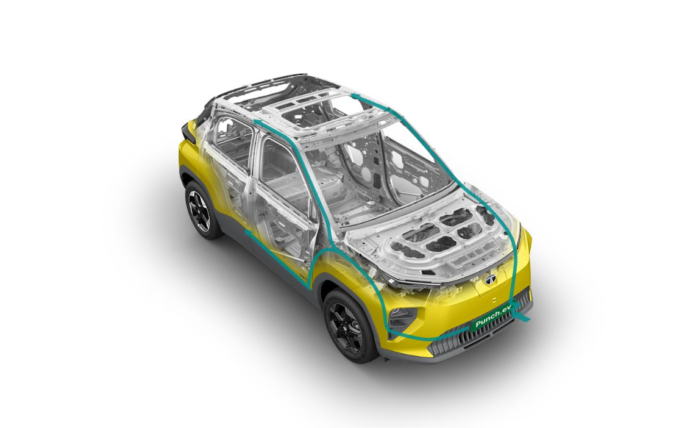
Even with all the changes, the car is still as safe as ever. This is due to enhanced structural safety through reinforced crush areas, engineered energy absorption paths, and strong electrical isolation throughout the battery system. Early models received a 5-star BNCAP rating, and newer versions have achieved the same standard. He noted that since the weight and structure remain stable, “rigidity or crash performance will not be affected.”
Advanced engineering, not higher costs
Today’s customers expect more power, longer range and more cabin space, all without a significant increase in cost. Achieving this balance is obviously a complex engineering and business challenge – achieving all these improvements without making the car expensive.
Mr. Kulkarni said: “The equation of capability has to be achieved at lower cost. Because the equation of getting more capability for more money is simple, but what is the disruption in it? So to achieve this, we made changes to the battery and electric drive.” The team achieved this through smarter battery design, integrated drive units and targeted cost optimization of non-battery components. Additionally, past experience helped refine several elements while keeping structural safety and rigidity intact. “It all adds up to a car that’s a great value but doesn’t cost a lot,” he explains.
“When the Punch EV debuted more than two years ago, it was built on one of the most structurally stiff platforms in its class – with levels of stiffness comparable to what you’d typically see in a luxury car,” he said. This inherent stiffness gives the vehicle a planted, confident feel, filtering out road disturbances and ensuring remarkable stability. In the latest upgrade, the redistribution of weight changes the balance by just 1%, leaving it almost at a 50:50 balance. As a result, no major structural changes or additional protective components are required, a fact further confirmed by the new BNCAP five-star certification, he said.
Get ready for the future of driver assistance
The updated model also has improved ADAS functionality, making it behave more like a calm, helpful co-pilot rather than an aggressive one. Mr. Kulkarni concluded that the system reflects the authentic Indian driving style, which is the first thing customers appreciate in the Harrier EV.