
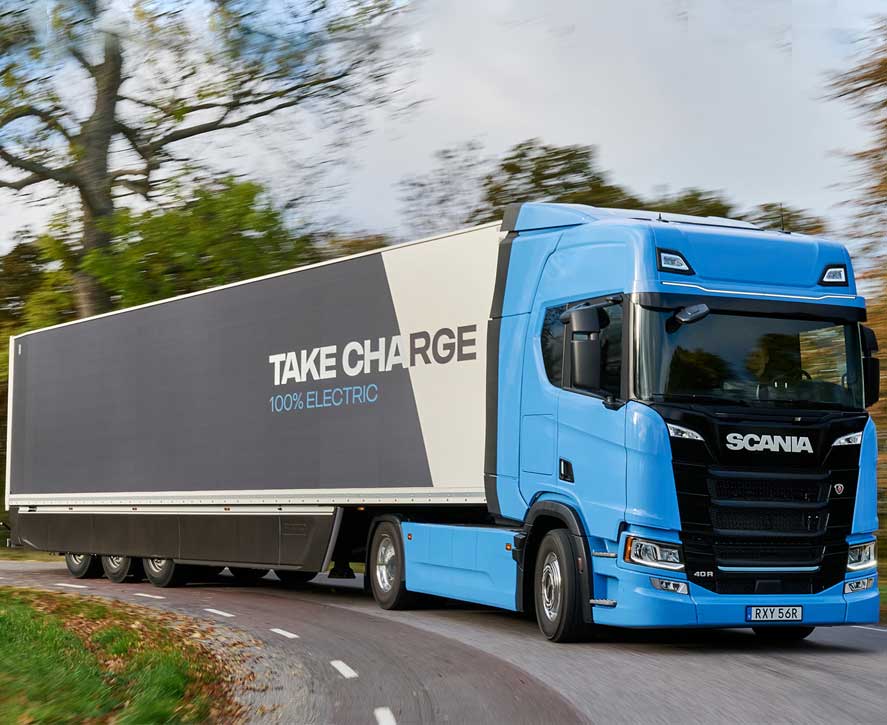
Scania has begun global sales of its new under-cab battery module and megawatt charging system (MCS), expanding the capabilities of its electric truck portfolio for long-haul and heavy-duty transportation applications.
The newly introduced under-cab battery module allows transport operators to more efficiently adapt battery capacity to a wider range of transport needs. According to Scania, the new configuration enables heavy-lift operations, advanced bodywork applications and the electrification of long-haul haulage with greater operational flexibility.
Scania said some applications equipped with the new battery solution can now achieve a driving range of more than 800 km on a single charge.
By installing the battery module below the cab, Scania has freed up additional chassis space for bodywork installation, while helping operators maintain an effective balance between driving range and payload capacity – one of the key challenges in heavy-duty electric transport.
The company said the modular battery layout allows greater adaptability across multiple transportation applications and body configurations.
Scania also highlighted that the EU’s revised gross train weight allowance rules introduced in 2025 now enable the company to offer a 400-kWh usable battery capacity option, capable of delivering a typical range of approximately 360 km without compromising payload capacity, even at the maximum legal weight limit.
The rollout of megawatt charging systems is expected to further improve charging efficiency and reduce downtime for long-haul electric truck operations, helping the broader shift towards sustainable heavy transportation solutions.
Scania’s MCS: the key to the right battery charging strategy
Another factor that transportation companies take into account is that battery capacity does not necessarily limit the range achievable. A common misconception about electric trucks is that their battery capacity should always be large enough for the worst case, and always optimized for a maximum range of, for example, 500 kilometers. However, if the transport assignment is only 300 kilometers, having a larger battery is, in many use cases, unnecessary, and may impact payload size.
Instead, it’s more about the charging strategy used for the job, and the introduction of Scania’s Megawatt Charging System (MCS) supports that need. Given the legally required rest breaks for drivers, transporters can plan for battery charging at natural stopping points during the trip, and from, say, 20 percent to 75 percent.
This is more than enough battery power to get the vehicle and its payload to the destination. Additional charges can be collected either at the delivery depot or while the truck is returning to base, helping to reduce both operating and capital expenses.
“The new under-cab battery module optimizes the placement of truck batteries for the benefit of transporters,” says Tobias Esderheim, Global Manager, Transformation and New Business at Scania. “Thus, with the right battery set-up, MCS and a good charging strategy – using Scania’s own charging company Erinion or Scania Charging Access on the road – our customers can easily solve the range versus payload question.”
“All of this just underlines the fact that haulage companies choosing Scania’s electric trucks are saving kilowatt hours, not transport, but freight, and reducing their overall cost of operation,” says Ejderham.
“Scania can now offer transport operators a comprehensive route to electrification and sustainable transport; one that is reliable, seamless and commercially viable,” says Lars Gustafsson, Head of Solution Management at Scania. “The transition to electric transportation becomes even easier and more attractive with these two new additions to customers’ arsenal.”