
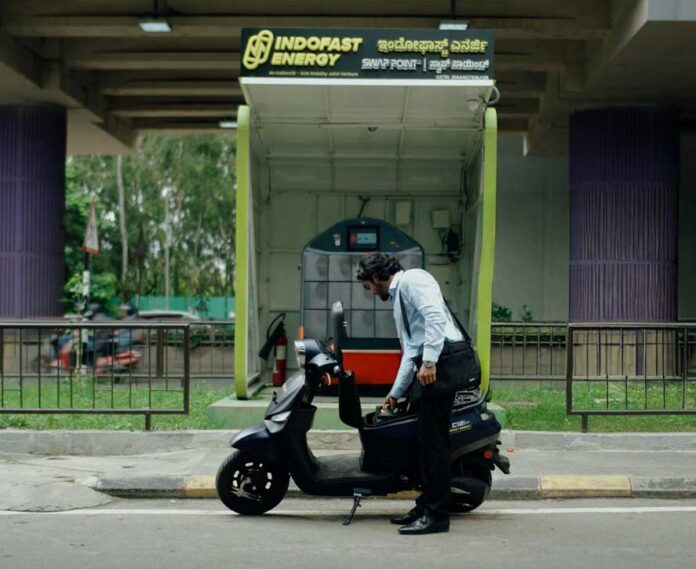

Indofast Energy has completed 100 million battery swaps across its nationwide network, marking a significant milestone in its efforts to support electric mobility adoption in India. The company said the achievement reflects its growing role in making EVs more accessible and affordable for individual riders, commercial fleets and gig workers.
Indofast Energy currently operates more than 2,200 battery-swapping stations across 24 cities and covers 163,000 vehicles. Many of these vehicles are used by commercial fleets and gig workers, for whom minimizing charging downtime is critical to daily operations.
According to the company, vehicles operating on its network have collectively covered 2.97 billion kilometers and helped save 13,277 metric tons of CO2 emissions. The battery-swapping model also offers economic benefits to riders, with running costs reported to be around 40% lower than conventional petrol-powered vehicles.
The 100-million-swap milestone highlights the growing role of battery-swapping infrastructure in supporting India’s electric mobility ecosystem, especially for high-usage vehicles and users who depend on their vehicles for daily earnings.
This milestone comes as two-wheelers and three-wheelers are leading India’s EV transformation. In FY2026, electric two-wheeler sales grew by 22% to a record 1.40 million units, while electric three-wheelers crossed 8.3 lakh units and now account for 61% of all three-wheelers sold in India. Maintaining this momentum depends on overcoming the obstacles that still deter many riders: long charging times, range anxiety and the upfront cost of batteries. Indofast’s battery swapping ecosystem provides solutions for two-wheelers, three-wheelers, e-loaders and electric rickshaws across 32+ OEM partnerships. Each battery undergoes rigorous testing and controlled charging, giving the network a strong safety record with zero fire incidents across 2.97 billion kilometers of vehicle operation. With road transport accounting for 12% of India’s energy-related CO2 emissions and the country committed to net zero by 2070, rapid electrification of these everyday vehicles is central to cleaner, more sustainable mobility.
Commenting on this milestone, Kamaldeep Singh, CEO, Indofast Energy, said, “Surpassing 100 million swaps demonstrates that battery swapping works at scale for India’s riders, and that the shift to clean mobility can be both affordable and practical. Our next phase will be driven by a greater focus on the customer: stations where riders need them, batteries that are always ready, and a service that is easy to use and pay for. As we Scale to over 10,000 stations in over 50 cities by 2030, we aim to make EVs a more affordable, accessible and convenient option for every rider.
To further broaden the reach, Indofast is promoting affordable retrofitting, which lets owners convert existing petrol two-wheelers to electric ones. Backed by strategic infrastructure partnerships with Indian Oil, Indian Railways and Metro corporations, the company plans to strengthen its presence in high-density urban areas, expand into tier-2 and tier-3 cities and deepen its ecosystem partnerships.
By 2030, Indofast aims to bring battery swapping within reach of over 1 million EV users, expand its network more than four-fold to over 10,000 stations across 50+ cities and support India’s clean mobility ambitions and net-zero targets.