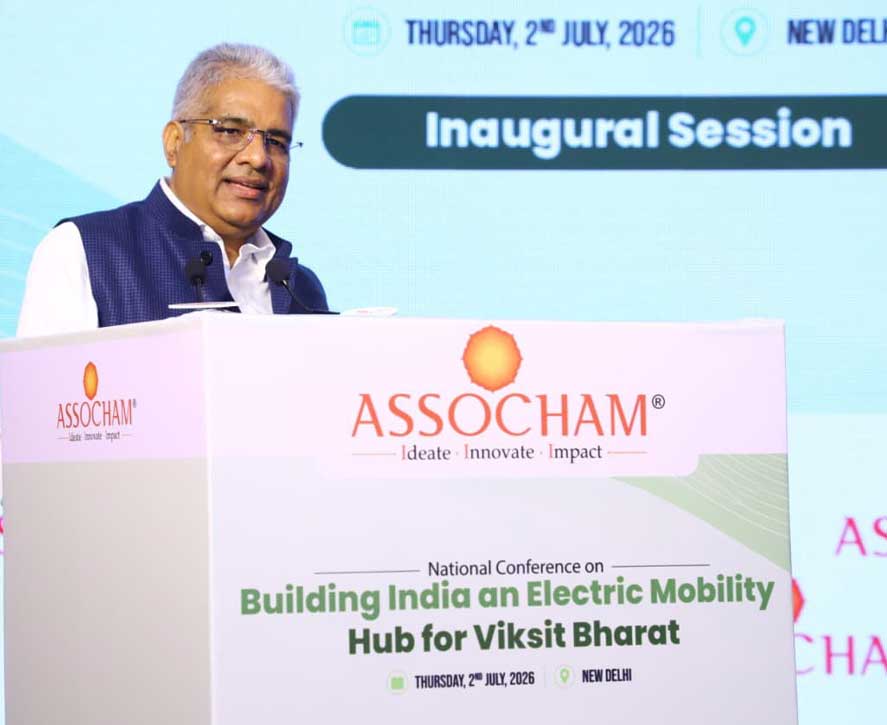
Union Minister for Environment, Forest and Climate Change Shri Bhupendra Yadav said India’s transition to electric mobility must be driven by green growth, sustainable infrastructure, transparent governance and a circular economy. Addressing the ASSOCHAM National Conference on Building India as an Electric Mobility Hub for a Developed India, the Minister emphasized that the government’s ongoing policy reforms are focused on accelerating sustainable industrial growth while enhancing the ease of doing business. He said that faster regulatory processes and circular economy practices as well as strengthening environmental governance will play a key role in establishing India as a global hub for electric mobility.
Mr Yadav said India’s clean mobility journey extends far beyond replacing conventional vehicles and requires a future-ready manufacturing ecosystem based on localisation, flexible supply chains, battery recycling, critical minerals, digital governance and responsible environmental stewardship. He also highlighted initiatives like faster environmental clearance, simplified compliance, expansion of ambient digital platforms with AI-enabled decision support, longer validity of approvals and promoting a circular economy.
The conference was attended by Shri Tarun Kapoor, Advisor to the Hon’ble Prime Minister; Mr. Nirmal K. Minda, President, ASSOCHAM and President, UNO Minda; Shri Nishant Arya, Chairman, ASSOCHAM National Council on Green Mobility and Vice Chairman and Managing Director, JBM Group; With senior policy makers, industry leaders and technology experts.
Hon’ble Minister of Environment, Forest and Climate Change, Shri Bhupendra Yadav said: “India’s transformation to electric mobility must be seen as part of a larger vision of sustainable industrial growth. As we move towards a developed India, our reforms must be guided by four priorities – green growth, improving quality of life, resilient infrastructure and transparent governance. The Government has also taken steps to simplify environmental clearances, strengthen digital governance through PARIvesh, reduce approval timelines and ease of doing business. The future of electric mobility depends on strong domestic manufacturing capabilities, secure critical minerals supply chains, and a circular economy where ecology and economy go hand in hand, enabling sustainable growth, greater competitiveness and long-term prosperity.
In his special address, Advisor to the Hon’ble Prime Minister, Shri Tarun Kapoor said: “Electric mobility is no longer just an environmental priority – it has become an economic and strategic imperative for India. While India has made encouraging progress especially in the two-wheeler and three-wheeler sectors, the next phase should focus on accelerating commercial vehicles, buses and freight transportation. It is equally important to develop domestic capabilities in batteries, motors, power electronics and critical minerals to create and strengthen resilient supply chains. India’s self-reliance. With continued policy support and industry participation, India has the opportunity to emerge as a global manufacturing and technology hub.
Welcoming the delegates, Shri Nirmal K Minda, President of ASSOCHAM and President of UNO MINDA, said: “Electric mobility represents one of India’s most significant industrial transformation opportunities and will play a decisive role in achieving the vision of Developed India 2047. Beyond vehicles, this includes advanced manufacturing, battery technology, charging infrastructure, renewable energy integration and digital innovation. Government initiatives such as PM e-Drive and production linked incentive schemes have Going forward, deeper collaboration between government, industry, financial institutions, startups and academia will be key to building a globally competitive supply chain and establishing India as a preferred destination for clean mobility manufacturing and innovation.
Addressing the conclave, Mr. Nishant Arya, Chairman, ASSOCHAM National Council on Green Mobility and Vice Chairman and Managing Director, JBM Group, said: “India is one of the fastest growing electric mobility markets in the world, and the opportunity extends far beyond EV adoption. Our aspiration should be to design, engineer and manufacture electric mobility solutions in India for the world. Localization, flexible supply to build a globally competitive ecosystem series, advanced battery technologies, charging infrastructure, strong partnerships between government and industry, India can emerge as a global hub for electric mobility manufacturing, engineering excellence and clean technology exports, creating opportunities for MSMEs, startups and the broader manufacturing ecosystem.
The conclave comprised four thematic sessions covering policy and financing, charging infrastructure, battery ecosystem and critical minerals, circular economy, localization and smart mobility. Senior representatives from Government of Tamil Nadu, BSES Rajdhani Power, Hyundai Motors, Newton Auto, Lohum Cleantech Pvt Ltd, Everta, Omega Seiki Mobility, Atero Recycling and other leading organizations deliberated on the roadmap to accelerate India’s clean mobility transition.
Speaking at the conclave, Sri Thiru. D. Mohan, Managing Director, Metropolitan Transport Corporation (Chennai) Limited, Government of Tamil Nadu, said: “India’s transition to electric mobility has reached a pivotal stage, and progressive policy initiatives like the Delhi EV Policy provide a strong blueprint to accelerate adoption across states. The need of the hour is to move towards faster implementation through strengthening charging infrastructure, expanding electric public transport and creating a supportive ecosystem for industry and consumers. Public Transport will play a vital role in this transformation. Through collaborative efforts between governments and industry, India can build a cleaner, more energy-secure and sustainable mobility ecosystem, furthering the vision of a developed India.
Delivering the vote of thanks, Shri Saurabh Sanyal, Secretary General, ASSOCHAM thanked Hon’ble Minister Shri Bhupendra Yadav, Shri Tarun Kapoor, distinguished speakers, policy makers, industry leaders and representatives for their participation. He reaffirmed ASSOCHAM’s commitment to work closely with government and industry through policy advocacy, industry collaboration and knowledge sharing to strengthen India’s electric mobility ecosystem and contribute to the vision of a developing India.